Choosing an industrial remover for food manufacturing facilities requires careful attention to the type of contamination, surface material and risk of chemical residue. Food factories may need to manage rust, grease, oil, adhesive deposits and other industrial stains on equipment and maintenance surfaces. However, a multipurpose industrial remover is not automatically suitable for food production areas. Buyers must verify its intended applications and food-safety suitability before use.
Why Do Food Manufacturing Facilities Need Specialised Cleaning Chemicals?
Food manufacturing facilities contain machinery, processing equipment, storage areas, maintenance workshops and packaging sections. Different areas develop different cleaning challenges.
Common problems include:
- Rust formation on compatible metal tools and equipment.
- Oil and grease deposits around machinery.
- Adhesive and sealant residues from maintenance work.
- Dirt and industrial stains on external equipment surfaces.
- Deposits on tools, fixtures and workshop components.
These problems may require different cleaning products. A rust remover, degreaser and general-purpose cleaner do not necessarily perform the same function.
The key is to select a chemical based on the contamination and the intended cleaning area, rather than assuming one product can handle every task.
What Should You Check Before Selecting an Industrial Remover?
1. Identify the Contamination
Start by identifying the material that needs to be removed.
| Contamination | What to check |
|---|---|
| Rust | Confirm that the product is designed for the affected metal |
| Oil and grease | Check whether the product has degreasing applications |
| Adhesive and sealant | Confirm that the product is intended for these residues |
| General industrial stains | Review the product’s stated cleaning applications |
| Food residue | Follow the facility’s approved food hygiene cleaning procedure |
A product that removes rust may not be the right choice for removing food deposits or sanitising equipment.
2. Check Surface Compatibility
Food factories use different materials, including stainless steel, aluminium, cast iron, chrome and coated metal.
Before selecting a chemical, confirm:
- Whether the product is suitable for the specific metal.
- Whether it can affect coatings, paint or protective finishes.
- Whether it is suitable for the equipment’s operating environment.
- Whether a small-area compatibility test is required.
Do not assume that a chemical suitable for one metal can be used on every equipment surface.
3. Verify Food-Area Suitability
This is one of the most important checks for food manufacturers.
A cleaning chemical used in a workshop may not be suitable for a food production environment. Product residue, incorrect application or inadequate removal can create a contamination risk.
Ask the manufacturer for written confirmation of:
- Approved applications and permitted cleaning areas.
- Whether the product can be used near food or packaging.
- Required rinsing and residue-removal procedures.
- Surface compatibility and handling instructions.
- Relevant technical documents and Safety Data Sheet (SDS).
If the manufacturer does not confirm suitability for the intended food-area application, do not use the product there.
How to Manage Industrial Cleaning in Food Factories
A planned cleaning procedure helps teams control chemical use and maintain separation between production and maintenance activities.
Step 1: Divide the Facility into Cleaning Zones
Identify production areas, food-contact equipment, packaging sections, storage areas and maintenance workshops. Define which products and tools are approved for each zone.
Step 2: Identify the Required Cleaning Task
Determine whether the problem involves rust, oil, grease, adhesive or general dirt. Select a product specifically intended for that task.
Step 3: Review Product Instructions
Check dilution, application method, contact time, rinsing requirements and protective equipment. Never estimate chemical quantities or mix different cleaning products.
Step 4: Protect Food and Packaging
Before cleaning, follow the facility’s procedures for stopping operations and protecting exposed ingredients, food products and packaging materials.
Step 5: Remove Chemical Residue as Directed
Follow the manufacturer’s instructions for wiping or rinsing. Do not restart equipment until the cleaning area has been inspected and cleared according to the plant’s procedure.
Step 6: Record and Review
Document cleaning activities, report recurring contamination and review whether the selected product is appropriate for the task.
How Does Eco-All In One Fit This Requirement?
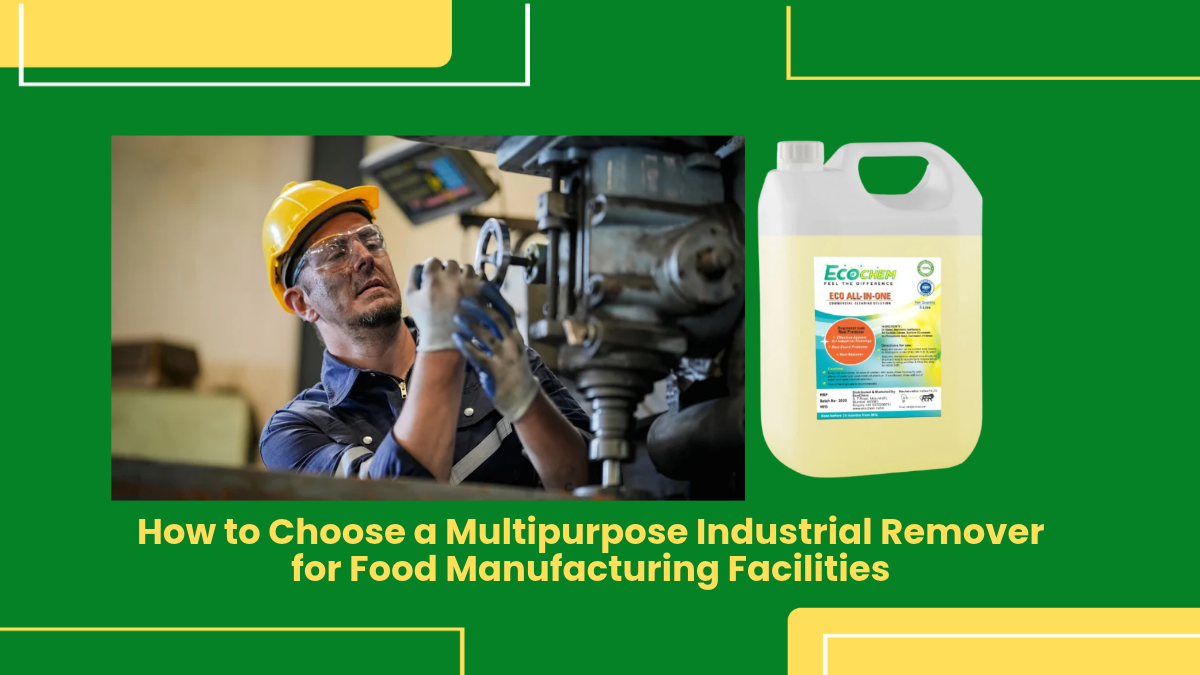
Ecochem’s Eco-All In One is listed as a multipurpose industrial remover. Its official product page describes applications involving rust removal, degreasing and rust protection on metal surfaces, including tools, cast iron and chrome parts. The page also lists a dilution ratio of 10 ml per litre of water.
However, there is an important limitation for food manufacturers: Ecochem’s own product FAQ states that Eco-All In One is not recommended for food processing and manufacturing facilities, because product residue may contaminate food products.
For this reason, food processing businesses should not select Eco-All In One for their production or food manufacturing areas based on its general industrial cleaning applications.
If your facility needs a chemical for a specific maintenance or industrial cleaning task, contact Ecochem to discuss an alternative product and obtain written confirmation of its suitability for the intended area.
View the Eco-All In One Multipurpose Industrial Remover product information.
Common Mistakes to Avoid
- Assuming every multipurpose remover is suitable for food factories.
- Using industrial chemicals on food-contact surfaces without approval.
- Ignoring product residue and rinsing requirements.
- Applying chemicals without checking surface compatibility.
- Mixing different cleaning products.
- Using a rust remover as a disinfectant.
- Selecting products based only on price or broad marketing claims.
FAQ’S
What is an industrial remover used for?
Industrial removers address specific contaminants such as rust, grease, oil, adhesive deposits and other industrial stains.
Can every multipurpose industrial remover be used in food factories?
No. Confirm the manufacturer’s approval for the intended area and application before using any industrial cleaning chemical.
What should food manufacturers check before buying cleaning chemicals?
Review contamination type, surface compatibility, application instructions, residue removal, safety information and food-area suitability.
Is Eco-All In One recommended for food processing facilities?
No. Ecochem’s official product FAQ states that Eco-All In One is not recommended for food processing and manufacturing facilities.
Can an industrial remover replace a disinfectant?
No. Removing industrial deposits and disinfecting surfaces are different tasks requiring products approved for their respective applications.
Written By: Vinny Jain