Introduction
Choosing the right floor cleaning chemicals for pharmaceutical industry facilities is important for maintaining clean production-support areas, corridors, packaging sections and other designated spaces. Pharmaceutical floors can accumulate dust, dirt, footwear marks and material residues due to regular employee and trolley movement.
A suitable floor cleaner should match the floor material, type of dirt, cleaning frequency and facility cleaning procedure. Pharmaceutical manufacturers must also consider chemical residues, surface compatibility and contamination-control requirements.
The right cleaning approach combines an appropriate chemical, dedicated cleaning equipment, trained housekeeping staff and documented procedures.
2. Common Floor Cleaning Challenges in Pharmaceutical Facilities
Pharmaceutical manufacturing facilities contain different areas, each with specific housekeeping requirements.
Common floor-cleaning challenges include:
- Dust accumulation: Dust and particles can collect around corridors, storage areas and production-support spaces.
- Footwear marks: Employees and visitors may carry dirt into changing rooms and common areas.
- Material spills: Accidental spills can leave visible marks and require immediate attention under approved procedures.
- Trolley movement: Regular movement of material-handling equipment can leave scuff marks and dirt.
- Frequent cleaning requirements: Busy areas need planned cleaning schedules to maintain consistent conditions.
- Cleaning chemical residues: Incorrect preparation or application can leave unwanted residues on flooring.
These problems make it important to select chemicals based on the actual cleaning requirement rather than using one product throughout the facility.
3. How to Choose Floor Cleaning Chemicals for Pharmaceutical Industry
Before selecting a floor cleaner, facility managers and procurement teams should evaluate the following factors.
A. Floor Material Compatibility
Pharmaceutical facilities may have ceramic tiles, epoxy flooring, marble, vinyl and other industrial flooring materials.
A cleaning chemical suitable for ceramic tiles may not be suitable for every coated or specialised floor.
Check the manufacturer’s compatibility recommendations and test the product on a small area before wider use.
B. Type of Dirt and Cleaning Requirement
Identify the type of contamination before selecting a cleaning chemical.
- General dust and dirt require routine floor cleaning.
- Footwear marks may require a suitable surface cleaner.
- Grease and heavy industrial deposits may require a dedicated degreaser.
- Biological contamination requires an approved cleaning and disinfection procedure.
Do not assume that a general floor cleaner can handle every type of contamination.
C. Dilution and Application Instructions
The product’s dilution instructions should be clear and practical for housekeeping teams.
Check the recommended chemical-to-water ratio, preparation method, application procedure and rinsing requirements.
Use measuring equipment to prepare cleaning solutions accurately.
D. Residue and Rinsing Requirements
Pharmaceutical facilities should assess whether a cleaning chemical may leave residues after application.
Check the manufacturer’s instructions for rinsing and drying. This is particularly important in controlled areas where cleaning procedures form part of the facility’s contamination-control programme.
E. Product Documentation
Before purchasing, request the product label, technical information and Safety Data Sheet (SDS).
These documents help procurement, quality and safety teams evaluate the product for its intended application.
4. Practical Floor Cleaning Procedure for Pharmaceutical Plants
A consistent floor-cleaning procedure helps housekeeping teams maintain designated areas without creating additional contamination risks.
Recommended cleaning steps:
- Prepare the area: Follow the facility SOP and restrict access where necessary.
- Remove loose dirt: Use designated equipment to collect dust and visible debris.
- Prepare the solution: Measure the floor cleaner according to the manufacturer’s instructions.
- Apply the cleaner: Use an approved mop or floor-cleaning machine suitable for the floor material.
- Follow application instructions: Observe the specified contact time and rinsing requirements, if applicable.
- Allow the floor to dry: Prevent unnecessary water accumulation and display wet-floor warning signs.
- Inspect the surface: Check for remaining dirt, stains or chemical residues.
- Document the activity: Complete cleaning records according to the facility’s housekeeping SOP.
Cleaning equipment should be designated for specific areas to reduce the possibility of transferring dirt or contaminants between different facility zones.
5. GMP and Safety Considerations for Pharmaceutical Floor Cleaning
Floor cleaning is part of pharmaceutical facility housekeeping and contamination control.
Facility managers should consider:
- Establishing written floor-cleaning procedures.
- Assigning cleaning responsibilities to trained employees.
- Using dedicated or colour-coded cleaning equipment where required.
- Maintaining separate cleaning materials for different facility zones.
- Following chemical handling and storage instructions.
- Avoiding chemical mixing.
- Controlling spills according to approved procedures.
- Maintaining cleaning records and inspection results.
Important distinction: Routine floor cleaning is not the same as disinfection. Where microbial control is required, use a separately approved disinfectant according to the facility’s validated or otherwise approved procedure. A general floor cleaner should not automatically be considered a disinfectant.
Also, cleaning floors does not replace cleaning validation for product-contact equipment. GMP draft annex 15 Partie I.doc+1
6. How Eco-Green Flo Fits Pharmaceutical Floor Cleaning Requirements
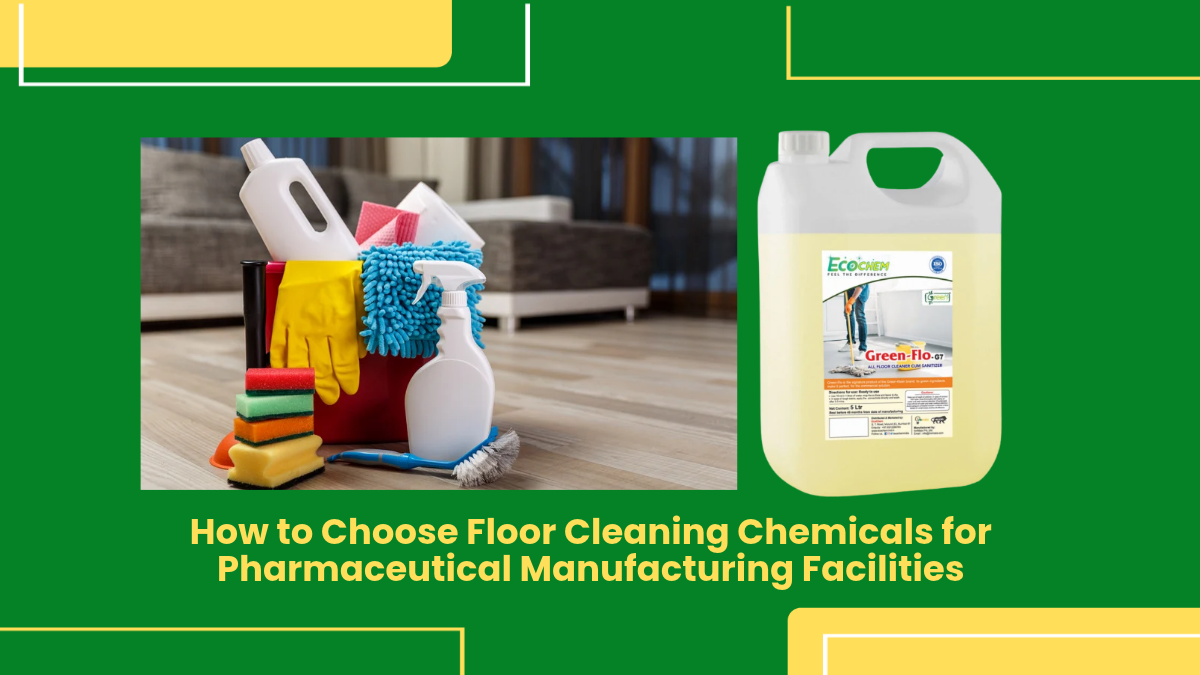
Eco-Green Flo by Ecochem
Eco-Green Flo is Ecochem’s floor-cleaning solution, intended for cleaning different floor surfaces. The official product page lists ceramic tiles, marble floors and lacquered surfaces among its applications.
Published dilution ratio: 10 ml in 1 litre of water.
According to Ecochem’s product information, Eco-Green Flo has the following stated features:
- Floor-cleaning concentrate.
- Intended for cleaning ceramic tiles and marble surfaces.
- Listed for lacquered surfaces.
- Published dilution ratio of 10 ml per litre of water.
- Fragrance added to the formulation.
For pharmaceutical facilities, Eco-Green Flo may be evaluated for suitable routine floor-cleaning applications in compatible areas, subject to the facility’s approval and the flooring manufacturer’s recommendations.
Before introducing it into a pharmaceutical facility, confirm:
- Compatibility with the specific flooring material.
- Current dilution and application instructions.
- Rinsing and drying requirements.
- Suitability for the intended facility area.
- Whether additional disinfection is required under the facility SOP.
Ecochem describes the product as having sanitising properties on its website. However, antimicrobial effectiveness should not be assumed without appropriate supporting efficacy documentation. It should not automatically replace an approved pharmaceutical facility disinfectant.
Explore the Eco-Green Flo Floor Cleaner for product information.
7. Common Floor Cleaning Mistakes to Avoid
Pharmaceutical housekeeping teams should avoid:
- Using the same cleaner on every flooring material.
- Preparing cleaning solutions without measuring dilution.
- Using dirty mops across different facility zones.
- Allowing cleaning solutions to remain on floors unnecessarily.
- Ignoring wet-floor safety precautions.
- Mixing different cleaning chemicals.
- Using general floor cleaners in controlled areas without approval.
- Treating routine floor cleaning as a substitute for disinfection.
A clear cleaning schedule and proper staff training help reduce these mistakes.
8. Floor Cleaning Checklist for Pharmaceutical Facilities
Facility managers can use this checklist to monitor routine housekeeping activities.
- Remove dust and loose particles.
- Inspect floors for visible dirt and stains.
- Check for accidental spills.
- Select a compatible floor-cleaning chemical.
- Prepare the solution according to instructions.
- Use designated cleaning equipment.
- Follow rinsing and drying requirements.
- Display wet-floor warning signs.
- Inspect the cleaned floor.
- Record cleaning activities according to the SOP.
Cleaning frequency should depend on the facility’s area classification, operational activity and documented cleaning requirements.
Conclusion
Choosing suitable floor cleaning chemicals for pharmaceutical industry facilities requires careful consideration of flooring materials, cleaning requirements, chemical residues and facility procedures.
Pharmaceutical manufacturers should establish documented cleaning schedules and ensure that housekeeping teams use appropriate chemicals and dedicated equipment for each area.
Ecochem’s Eco-Green Flo is an option to evaluate for routine floor cleaning on compatible surfaces. Before procurement, confirm its suitability for the intended pharmaceutical facility area and whether separate disinfection is required.
FAQ’S
Which floor cleaning chemicals are suitable for pharmaceutical manufacturing facilities?
Choose floor cleaners compatible with the flooring material, facility requirements and documented housekeeping procedures.
How often should pharmaceutical factory floors be cleaned?
Cleaning frequency depends on area classification, employee movement, operational activity and the facility’s approved cleaning schedule.
Can a general floor cleaner be used in pharmaceutical production areas?
Only after quality and facility teams assess its suitability and approve it for the intended area.
What is the dilution ratio of Ecochem Eco-Green Flo?
Ecochem lists 10 ml of Eco-Green Flo per litre of water. Follow the latest manufacturer instructions.
Is floor cleaning the same as floor disinfection?
No. Cleaning removes dirt and residues, while disinfection requires an appropriate product with demonstrated antimicrobial effectiveness.