Introduction
Removing ink and stubborn stains from pharmaceutical facility walls requires suitable cleaning chemicals, surface compatibility checks and controlled cleaning procedures. A suitable stain remover for pharmaceutical facilities can help housekeeping teams address ink marks, paint stains and other visible marks on approved surfaces.
Pharmaceutical facilities have different areas, including office corridors, reception spaces, changing rooms, visitor areas and manufacturing sections. Each area has specific cleaning requirements, and the wrong chemical or cleaning method can damage painted walls or interfere with established hygiene procedures.
Facility managers should therefore select stain removers according to the stain type, wall material and intended application.
2. Common Causes of Wall Stains in Pharmaceutical Facilities
Walls and shared areas experience regular employee movement, maintenance activities and material handling. These activities can leave visible marks.
Common examples include:
- Ink marks: Pen marks and accidental ink spills on walls, doors and work surfaces.
- Paint stains: Marks caused during facility maintenance, repairs or painting activities.
- Paan and gutka stains: Stubborn stains that may appear in entrances, external walls and shared areas.
- Dust and dirt marks: Accumulation around corners, doors, corridors and frequently touched surfaces.
- Footwear and trolley marks: Scuff marks around corridors, storage areas and movement routes.
If stains are not addressed appropriately, they can become harder to remove and affect the appearance of the facility.
3. How to Choose a Stain Remover for Pharmaceutical Facilities
Selecting the correct cleaning chemical is important because different stains require different cleaning approaches.
A. Identify the Stain Type
Before selecting a product, identify whether the mark is caused by ink, paint, dirt, grease or another substance.
A chemical intended for ink stains may not be appropriate for every type of surface contamination.
B. Check Wall Surface Compatibility
Pharmaceutical facilities may have painted walls, washable coatings, tiles, metal panels and other finishes.
Before applying a stain remover:
- Check the manufacturer’s surface recommendations.
- Test the product in a small, hidden area.
- Check for colour fading or coating damage.
- Avoid applying chemicals to damaged or peeling paint without assessment.
C. Review Product Instructions
A suitable stain remover should have clear application and handling instructions.
Check the recommended dilution, application method, waiting time and rinsing requirements. Do not assume that every stain remover should be applied directly or used at the same concentration.
D. Consider Facility Cleaning Requirements
Cleaning products used in pharmaceutical facilities should be approved for their intended locations.
A product suitable for an administrative corridor should not automatically be introduced into a controlled manufacturing area or used on product-contact surfaces.
4. Practical Steps to Remove Ink and Stubborn Wall Stains
Housekeeping teams should follow a consistent procedure when removing stains from approved wall surfaces.
Step 1: Inspect the stain
Identify the stain type, affected area and wall finish before starting.
Step 2: Remove loose dirt
Use a clean, suitable cloth to remove loose dust without spreading it across the wall.
Step 3: Check product compatibility
Review the stain remover’s instructions and test it on an inconspicuous section.
Step 4: Prepare the cleaning solution
Measure the chemical according to the manufacturer’s specified dilution instructions.
Step 5: Apply the product
Use the recommended application method. Avoid excessive application, particularly on painted surfaces.
Step 6: Clean and rinse
Follow the specified waiting time and rinsing procedure. Use clean water where instructed.
Step 7: Inspect the surface
Check whether the stain has been removed and whether the wall coating remains intact. Record the cleaning activity where required by the facility SOP.
5. GMP and Safety Considerations
Pharmaceutical facilities must manage cleaning activities carefully to reduce contamination risks.
India’s revised Schedule M and pharmaceutical GMP guidance emphasise suitable premises, cleaning procedures and contamination-control practices. CDSCO+1
Consider these precautions:
- Use approved chemicals in designated areas.
- Keep cleaning equipment separate between general and controlled areas.
- Follow the product label and Safety Data Sheet (SDS).
- Wear the protective equipment specified by the manufacturer.
- Do not mix different cleaning chemicals.
- Prevent cleaning solutions from contacting exposed materials or products.
- Maintain cleaning records according to internal procedures.
- Use separately approved disinfectants wherever disinfection is required.
Remember: Removing a visible stain does not automatically disinfect a surface or establish that it meets pharmaceutical hygiene requirements.
6. How Eco-Green Kleen Eraser Fits Pharmaceutical Facility Cleaning
Eco-Green Kleen Eraser by Ecochem
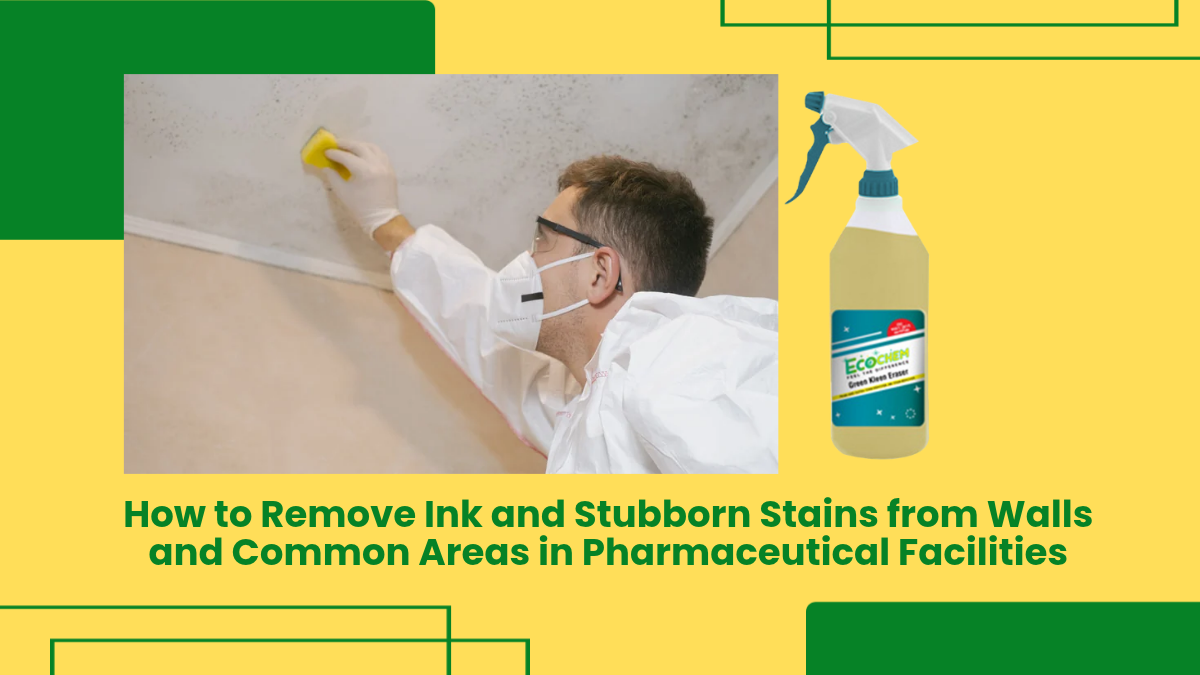
Eco-Green Kleen Eraser is a stain-removal product intended for removing paan, gutka, ink and paint stains from industrial walls, grills, corners and common areas.
Published product dilution: 10 ml in 1 litre of water.
According to Ecochem’s official product page, the product has the following stated applications and features:
- Intended for paan and gutka stain removal.
- Recommended for ink and paint stains.
- Designed for industrial walls, grills and corners.
- Listed for common-area cleaning applications.
- Published dilution ratio of 10 ml per litre of water.
For pharmaceutical facilities, Eco-Green Kleen Eraser may be evaluated for suitable stain-removal applications in approved common areas, such as selected corridors, external walls and other compatible surfaces.
Before using it, facility managers should:
- Check compatibility with the existing wall coating.
- Review the latest product label and SDS.
- Follow the manufacturer’s dilution and application instructions.
- Wear rubber gloves as directed by Ecochem.
- Test the product on a small, inconspicuous area.
Important product-handling note: Ecochem’s website provides a diluted-use ratio but also warns against direct handling of the liquid and recommends gloves. Confirm the current application instructions with Ecochem before use. Do not assume the product is suitable for cleanrooms, product-contact surfaces or validated cleaning procedures.
Explore the Eco-Green Kleen Eraser Stain Remover for product information.
7. Common Mistakes to Avoid During Wall Stain Removal
Housekeeping teams should avoid these practices:
- Applying concentrated chemicals without checking instructions.
- Scrubbing painted walls with abrasive brushes.
- Using the same cleaning solution on every wall material.
- Ignoring surface compatibility testing.
- Mixing different stain-removal chemicals.
- Allowing cleaning solutions to dry without following rinsing instructions.
- Using general-purpose stain removers in controlled areas without approval.
- Treating stain removal as a substitute for disinfection.
8. Wall Cleaning and Maintenance Checklist
Facility managers can use this checklist to maintain common areas.
- Inspect corridors and entrance walls for visible stains.
- Check reception and visitor areas regularly.
- Identify ink, paint and other stubborn marks.
- Select a compatible cleaning chemical.
- Test the product before wider application.
- Use designated cleaning equipment.
- Follow chemical handling instructions.
- Inspect cleaned surfaces for damage.
- Record cleaning activities according to facility SOPs.
A planned inspection schedule helps housekeeping teams identify stains before they become difficult to manage.
Conclusion
Removing ink and stubborn stains from pharmaceutical facility walls requires the right stain remover, suitable application methods and proper surface compatibility checks.
Facility managers should establish clear cleaning procedures for corridors, reception areas, common spaces and other designated locations. They should also ensure that cleaning products used in general areas are not automatically introduced into controlled manufacturing environments.
Ecochem’s Eco-Green Kleen Eraser is an option to evaluate for ink, paint, paan and gutka stain removal on compatible surfaces. Selecting the right product and following its instructions can help housekeeping teams maintain cleaner and better-presented pharmaceutical facilities.
FAQ’S
Which stain remover is suitable for pharmaceutical facilities?
Choose a stain remover according to the stain type, wall material, product instructions and facility approval requirements.
How can ink stains be removed from pharmaceutical facility walls?
Identify the wall coating, test a compatible stain remover and follow its specified application and rinsing instructions.
Can industrial stain removers be used on painted walls?
Only after checking manufacturer recommendations and testing compatibility to prevent paint fading, discolouration or coating damage.
What is Eco-Green Kleen Eraser used for?
Ecochem lists it for removing paan, gutka, ink and paint stains from industrial walls and common areas.
Can stain removers be used in pharmaceutical cleanrooms?
Only if specifically assessed and approved under the facility’s cleaning procedures and contamination-control requirements.