Introduction
Pharmaceutical manufacturing facilities require organised cleaning practices to maintain workplace hygiene, protect equipment and reduce contamination risks. Choosing the right multipurpose cleaner for the pharmaceutical industry helps facility managers manage routine cleaning across approved non-critical surfaces.
A suitable cleaner should match the surface material, type of dirt, cleaning procedure and intended application. It should also have clear usage instructions and documented product information. However, a general-purpose cleaner should not replace validated cleaning agents, disinfectants or sanitisation procedures required in pharmaceutical production.
For pharmaceutical manufacturers, the selection process should consider cleaning performance, surface compatibility, chemical residues, handling requirements and regulatory procedures.
1. Common Cleaning Challenges in Pharmaceutical Manufacturing Facilities
Pharmaceutical plants contain production areas, laboratories, packaging sections, storage spaces and administrative areas. Each location has different cleaning requirements.
Common challenges include:
- Dust accumulation: Dust can collect on floors, workstations, shelves and external equipment surfaces.
- Surface stains: Regular operations may leave marks on floors, walls and other washable surfaces.
- Grease and dirt: Maintenance activities can cause grease and dirt accumulation around non-product-contact equipment.
- Frequent cleaning requirements: High-activity areas require planned housekeeping schedules.
- Cross-contamination risks: Incorrect cleaning procedures can transfer product residues or cleaning-agent residues between areas.
These challenges make it important to select cleaning chemicals according to the specific requirements of each facility.
2. How to Choose a Multipurpose Cleaner for the Pharmaceutical Industry
Before purchasing a multipurpose cleaning chemical, pharmaceutical facility managers should evaluate the following factors.
A. Surface Compatibility
Different surfaces require different cleaning approaches. A cleaner suitable for floor tiles may not be appropriate for sensitive equipment, coated surfaces or product-contact components.
Check whether the product is suitable for the intended surface. Conduct a compatibility assessment before introducing it into routine cleaning.
B. Cleaning Performance
Choose a cleaner according to the type of dirt and stains present in the facility.
For example:
- Dust and general dirt on washable surfaces.
- Routine stains on suitable floors and surfaces.
- Light grease accumulation in approved housekeeping areas.
For heavy industrial grease or specialised equipment residues, a dedicated cleaning chemical may be more appropriate.
C. Dilution and Application Instructions
A clear dilution ratio helps housekeeping teams prepare cleaning solutions consistently.
Check the manufacturer’s instructions for:
- Recommended dilution.
- Application method.
- Contact time, if specified.
- Rinsing requirements.
- Storage and handling precautions.
Never increase chemical concentration without manufacturer guidance.
D. Chemical Residue Considerations
Pharmaceutical facilities must consider the possibility of cleaning-agent residues remaining on surfaces.
Cleaning agents used on product-contact equipment must be evaluated as part of the site’s cleaning procedure. A general multipurpose cleaner should not be introduced into validated equipment-cleaning processes without appropriate technical assessment.
E. Product Documentation
Before procurement, request the relevant technical information, Safety Data Sheet (SDS), usage instructions and surface compatibility details.
This helps quality, safety and procurement teams assess whether a product meets the intended cleaning requirement.
3. Cleaning Best Practices for Pharmaceutical Facilities
Selecting a suitable chemical is only one part of an effective cleaning programme. Proper application and documentation are equally important.
Recommended routine cleaning approach:
- Identify the area and surface that requires cleaning.
- Remove loose dust and visible dirt using approved cleaning tools.
- Prepare the cleaning solution according to the product instructions.
- Apply the cleaner using the approved method.
- Follow the specified rinsing and drying requirements.
- Inspect the surface after cleaning.
- Record the activity according to the facility’s cleaning SOP.
Cleaning schedules should clearly identify responsibilities, approved chemicals and cleaning frequencies.
4. Safety and GMP Considerations
Good Manufacturing Practices (GMP) require pharmaceutical manufacturers to establish appropriate cleaning procedures to prevent contamination and cross-contamination.
The US FDA highlights the importance of documented cleaning procedures and cleaning validation for pharmaceutical manufacturing equipment. FDA+1
Keep these considerations in mind:
- Use only approved cleaning chemicals in designated areas.
- Follow the product’s SDS and handling instructions.
- Store chemicals in identified and designated containers.
- Train housekeeping staff in correct preparation and application.
- Keep cleaning records as required by facility SOPs.
- Do not mix different cleaning chemicals.
- Separate routine housekeeping from validated equipment cleaning and disinfection.
Important: A multipurpose cleaner removes dirt and residues according to its intended cleaning function. It should not automatically be considered a disinfectant or sterilising agent.
5. How Eco-Greener Fits Pharmaceutical Housekeeping Requirements
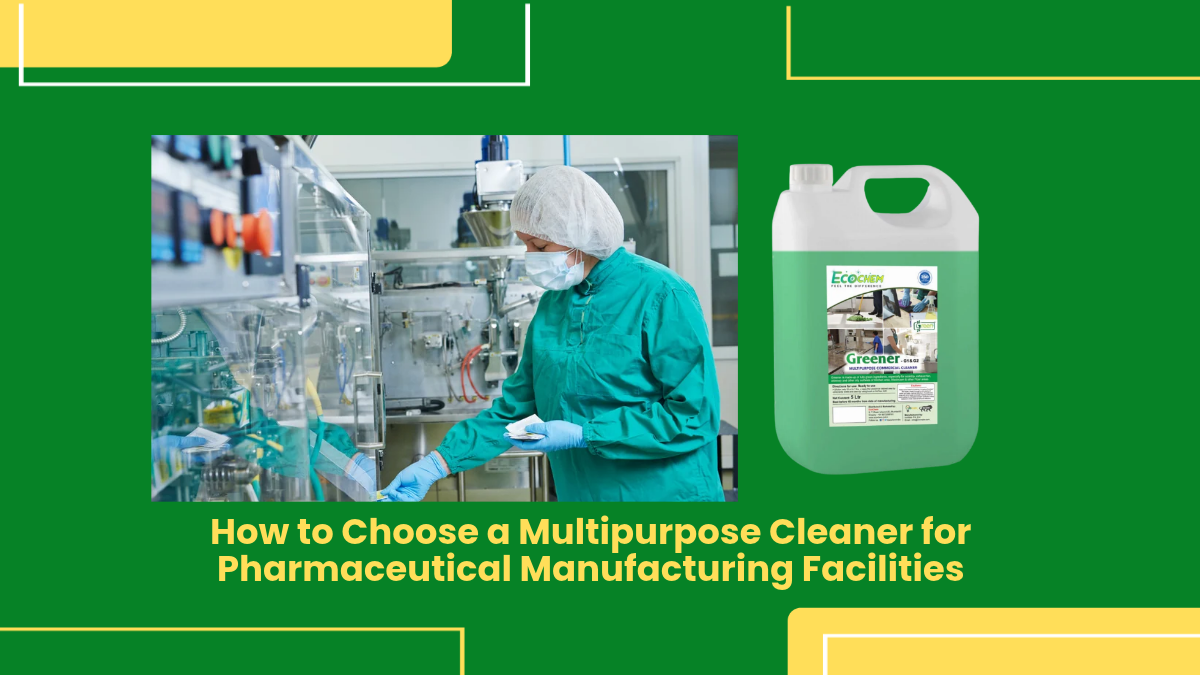
Eco-Greener by Ecochem
Eco-Greener is an acid-free, water-based multipurpose cleaning agent intended for different cleaning applications. Ecochem lists pharmaceutical facilities among its intended industry segments. Ecochem
Official product information: 10 ml in 1 litre of water dilution ratio.
According to Ecochem’s product page, Eco-Greener offers:
- Multipurpose cleaning applications.
- Acid-free formulation.
- Cleaning of accumulated dirt and grease.
- A stated dilution ratio of 10 ml per litre of water.
- Applications across different commercial and institutional environments.
For pharmaceutical facilities, Eco-Greener may be considered for suitable routine housekeeping applications, subject to surface compatibility and the facility’s approval process.
Its suitability for product-contact equipment, cleanrooms, validated cleaning procedures or disinfecting applications must be confirmed separately with Ecochem.
Explore the Eco-Greener Multipurpose Cleaner product page for further details.
6. Common Mistakes to Avoid When Selecting Cleaning Chemicals
Pharmaceutical manufacturers should avoid these common purchasing and housekeeping mistakes:
- Choosing a cleaner only because it is labelled multipurpose.
- Ignoring surface compatibility.
- Using incorrect dilution ratios.
- Treating a general cleaner as a disinfectant.
- Using unapproved chemicals in controlled production areas.
- Skipping cleaning inspections and documentation.
- Introducing a new chemical into validated procedures without assessment.
A well-planned selection process helps housekeeping and facility management teams maintain consistent cleaning practices.
Conclusion
Choosing the right multipurpose cleaner for pharmaceutical industry applications requires attention to cleaning performance, surface compatibility, dilution instructions and chemical safety.
Pharmaceutical manufacturers should select cleaning products according to their intended use and facility SOPs. Eco-Greener by Ecochem is one option to evaluate for suitable routine housekeeping requirements, subject to technical assessment and approval.
Explore Ecochem’s product range or contact the team to discuss cleaning chemical requirements for your pharmaceutical facility.
Frequently Asked Questions
What is a multipurpose cleaner used for in pharmaceutical facilities?
It is used for routine cleaning of approved surfaces, removing general dirt, dust and everyday stains in designated areas.
Can multipurpose cleaners be used on pharmaceutical manufacturing equipment?
Only when the product is approved for the equipment material and included in the applicable cleaning procedure.
What should pharmaceutical companies check before buying cleaning chemicals?
They should check surface compatibility, dilution instructions, SDS, cleaning performance and suitability for the intended application.
Is a multipurpose cleaner the same as a pharmaceutical disinfectant?
No. A multipurpose cleaner removes dirt, while disinfectants are specifically intended to control microorganisms under validated usage conditions.
What is the dilution ratio of Ecochem Eco-Greener?
Ecochem lists a dilution ratio of 10 ml per litre of water. Confirm current product instructions before application.
Written By: Vinny Jain