Food processing plants need effective cleaning procedures to manage oil, grease and grime around machinery and maintenance areas. Choosing an industrial degreaser for food processing plants requires checking the type of contamination, surface material, application area and product instructions. The right selection can help maintenance teams remove industrial grease without compromising equipment materials or food hygiene procedures.
An industrial degreaser is a cleaning chemical designed to loosen and remove oil, grease and similar deposits from compatible surfaces. However, a degreaser intended for general industrial use should not automatically be used on food-contact surfaces.
Why Do Food Processing Plants Need Industrial Degreasers?
Food processing facilities operate machinery, motors, conveyors, pumps, tools and other equipment that may develop oil and grease deposits during operation and maintenance.
Common sources include:
- Lubricating oil around machine components
- Grease deposits near motors and mechanical assemblies
- Oil marks on maintenance workshop floors
- Residue on tools used during equipment servicing
- Dirt and grime accumulating around machine bases
- Leaks from equipment requiring inspection and repair
If these deposits are not managed, they can make maintenance more difficult and create slippery conditions on floors. A planned cleaning procedure helps keep equipment surroundings and maintenance workspaces in good condition.
Where Can Degreasing Be Required in a Food Factory?
Not every area requires the same cleaning chemical. Maintenance teams should identify the location and contamination before selecting a product.
1. Machinery Exteriors
Oil and grease can collect on the outer surfaces of motors, machine frames and equipment housings. A suitable degreaser may help remove these deposits when the product is approved for the surface and application.
2. Maintenance Workshops
Tools, workbenches and equipment parts may accumulate grease during repair work. A dedicated degreasing procedure can help keep these workspaces clean.
3. Equipment Bases and Surrounding Areas
Grease can collect around machine supports, external frames and nearby floor sections. These areas need attention because oil deposits may contribute to slippery conditions.
4. Non-Food-Contact Metal Components
Some external metal components may require periodic degreasing. Check the chemical manufacturer’s surface-compatibility instructions before applying a product.
How to Select an Industrial Degreaser for Food Processing Plants
Before purchasing a food processing equipment degreaser, assess the following factors.
1. Identify the Type of Grease
First, determine whether the deposit is lubricating oil, mechanical grease, general grime or a mixture of contaminants. Different deposits may require different cleaning methods.
A product suitable for routine oil and grease removal may not be appropriate for every type of industrial residue.
2. Check Surface Compatibility
Identify the material being cleaned, such as stainless steel, aluminium, painted metal or plastic. Do not assume that a product suitable for one metal will work on another.
Ask the supplier for compatibility information and test the product on a small, inconspicuous area where appropriate.
3. Review Dilution Instructions
The correct concentration affects cleaning performance and chemical handling. Follow the manufacturer’s stated dilution rather than increasing the quantity to achieve faster results.
For example, Ecochem lists a dilution ratio of 10 ml per litre of water for Eco-Green Kleen. Confirm the current label and application instructions before preparing the solution.
4. Check Handling and Safety Information
Review the product label and Safety Data Sheet (SDS), where available. Check the recommended personal protective equipment, handling precautions, storage requirements and first-aid instructions.
5. Confirm Whether the Area Is Food-Contact or Non-Food-Contact
This is an essential consideration in food manufacturing. A general industrial degreaser should not be treated as a food-grade cleaner or used on food-contact surfaces unless the manufacturer provides the required confirmation for that application.
FSSAI guidance requires cleaning chemicals to be handled according to their instructions, with appropriate controls to prevent food contamination. Cleaning and disinfection are also separate steps; a degreaser should not be assumed to sanitise equipment.
Practical Steps for Degreasing Maintenance Areas
A consistent procedure helps cleaning teams work safely and achieve repeatable results.
- Prepare the area: Stop and isolate equipment according to the plant’s lockout and maintenance procedure. Protect nearby food, ingredients and packaging.
- Remove loose deposits: Wipe or scrape away loose grease and dirt using suitable tools.
- Prepare the solution: Follow the product label for dilution and preparation.
- Apply to the approved surface: Use the application method specified by the manufacturer. Avoid electrical components, sensitive parts and food-contact surfaces unless the product is specifically approved for them.
- Allow the specified contact time: Do not leave the chemical on the surface longer than instructed.
- Remove loosened contamination: Wipe, scrub or rinse as directed by the product instructions.
- Inspect the area: Check for remaining grease, chemical residue or surface changes.
- Document the task: Record the cleaning activity and report any equipment leaks or recurring grease deposits.
Before restarting equipment, maintenance staff should confirm that the area is clean, dry where required and safe for operation.
How Does Eco-Green Kleen Fit This Requirement?
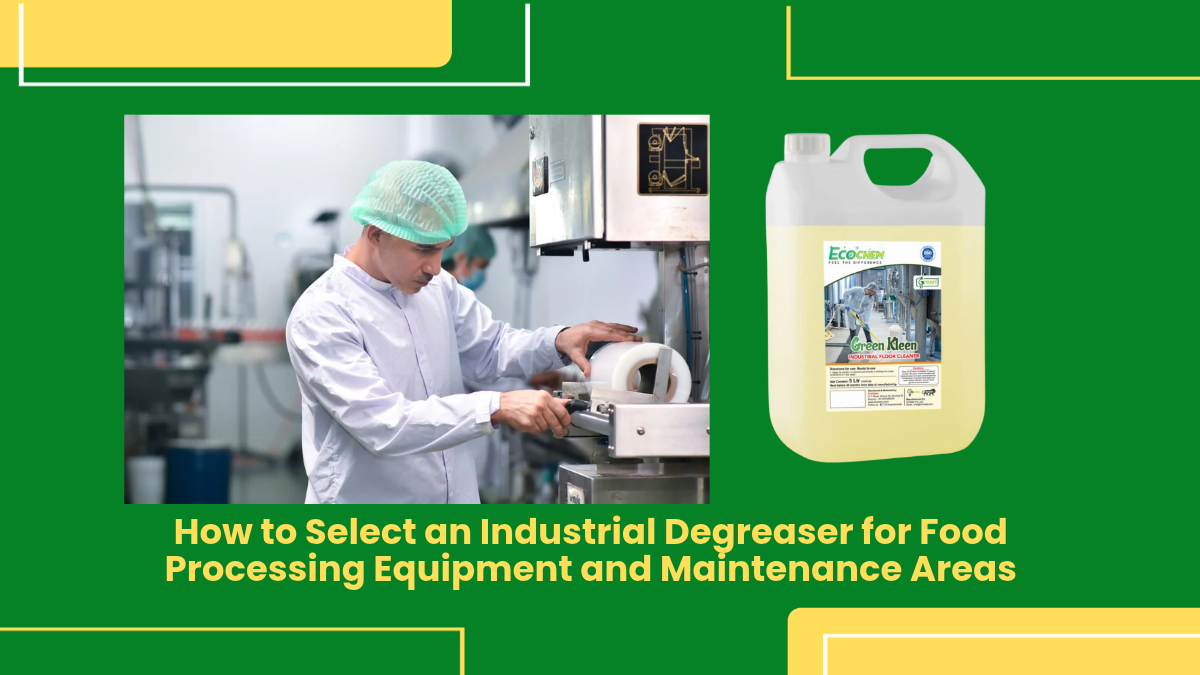
Ecochem’s Eco-Green Kleen is listed on its official website as a water-based, acid-free industrial degreaser. The product information describes its use for removing oil, grease, paint and other industrial stains associated with heavy machinery. The listed dilution ratio is 10 ml per litre of water.
Food processing facilities may evaluate it for suitable industrial degreasing requirements in maintenance areas, subject to confirmation of the specific application and surface compatibility.
The published product information does not establish that Eco-Green Kleen is food-grade, a disinfectant or approved for food-contact surfaces. Facilities should obtain confirmation from Ecochem before using it in or around production equipment where food contamination could occur.
Explore the Eco-Green Kleen Industrial Degreaser for the available product details.
Common Degreasing Mistakes to Avoid
- Using one cleaning chemical for every surface and application.
- Applying a general-purpose industrial degreaser to food-contact surfaces without approval.
- Increasing chemical concentration beyond the label instructions.
- Cleaning equipment without following isolation procedures.
- Allowing grease or cleaning residue to remain on floors.
- Mixing different cleaning chemicals.
- Ignoring recurring oil leaks instead of reporting the equipment problem.
FAQ’S
What is an industrial degreaser used for in food processing plants?
It removes oil, grease and related deposits from compatible machinery exteriors, tools and maintenance areas.
Can an industrial degreaser be used on food-contact equipment?
Only if the product is specifically confirmed as suitable for that food-contact application and used according to instructions.
How do I choose a degreaser for food factory machinery?
Check the grease type, surface material, application method, dilution instructions and product safety information.
What is the listed dilution ratio for Eco-Green Kleen?
Ecochem lists 10 ml per litre of water. Check the current product label before preparing the solution.
Does an industrial degreaser also disinfect equipment?
Not automatically. Degreasing removes oil and grease; disinfection requires a separately suitable and approved process.
Written By: Vinny Jain