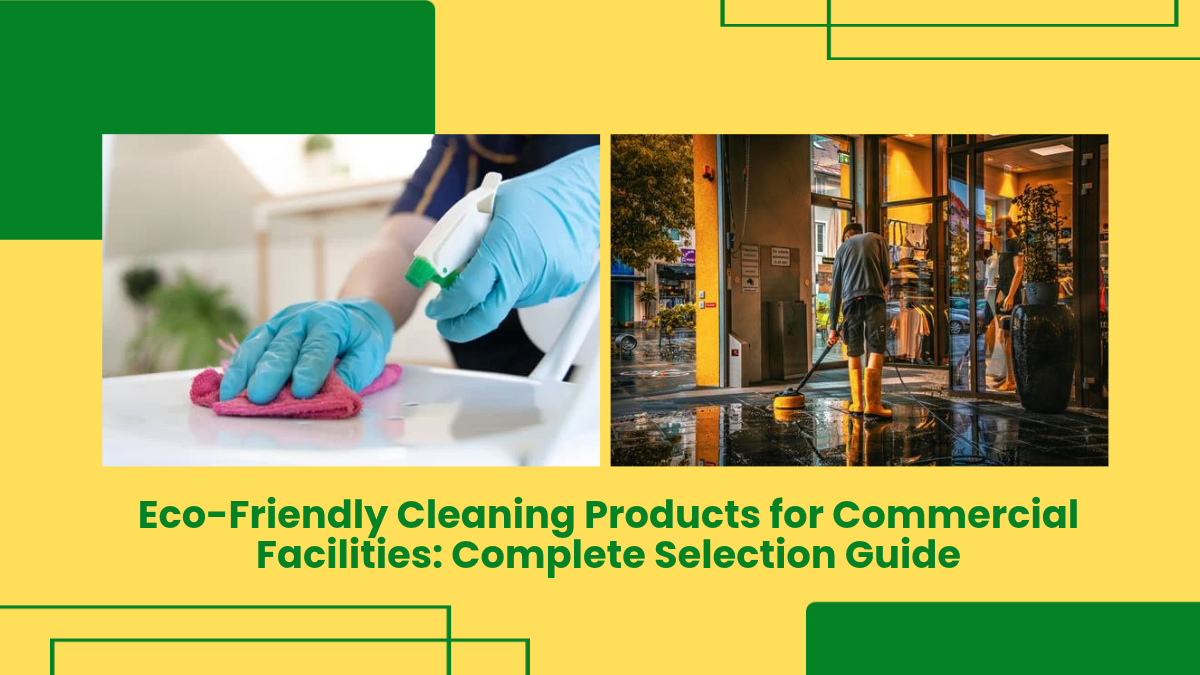
Commercial facilities need regular cleaning to maintain hygiene, protect surfaces, and provide a safe environment for employees, customers, visitors, and service staff. Offices, hospitals, schools, manufacturing units, food processing facilities, and commercial buildings all have different cleaning requirements.
Choosing the right eco-friendly cleaning products can help facilities reduce exposure to harsh chemicals while maintaining effective cleaning standards. However, selecting a suitable product is not simply about choosing a product labelled “green” or “eco-friendly.” Consider the formulation, intended use, cleaning performance, surface compatibility, handling requirements, and environmental profile.
This guide explains how commercial facilities can select green cleaning products, identify common cleaning problems, and build a practical cleaning chemical system.
What Are Eco-Friendly Cleaning Products?
Eco-friendly cleaning products are formulations designed with environmental impact, safer handling, and responsible use in mind, while still performing the required cleaning task.
Depending on the application, they may include formulations based on plant-derived ingredients, biodegradable components, enzymes, or other ingredients selected to reduce unnecessary environmental impact.
For commercial facilities, eco-friendly cleaning should not mean compromising on cleaning performance. The right product should match the type of soil, surface, cleaning frequency, and operating conditions.
Common categories include:
- Multipurpose cleaners
- Floor cleaning chemicals
- Toilet and bathroom cleaners
- Industrial degreasers
- Dishwashing products
- Hand wash products
- Enzyme-based cleaners
- Glass and surface cleaners
- Specialised industrial cleaning chemicals
Problems Commercial Facilities Face With Conventional Cleaning
Selecting cleaning chemicals without considering the facility’s requirements can create several problems.
1. Excessive Chemical Use
Using a stronger chemical than necessary does not always produce better cleaning. Incorrect dilution can increase chemical consumption, leave residues, damage surfaces, and increase operating costs.
2. Harsh Chemical Exposure
Cleaning staff may handle chemicals several times each day. Products with unnecessarily harsh formulations can create concerns related to skin, eyes, breathing comfort, and safe chemical handling.
Proper PPE, ventilation, storage, dilution, and training remain necessary even when using eco-friendly cleaning chemicals.
3. Surface Damage
Different materials react differently to cleaning chemicals. Marble, stainless steel, painted surfaces, tiles, glass, plastics, and floors may require different formulations.
A chemical suitable for removing grease from industrial equipment may not be appropriate for a delicate floor or bathroom surface.
4. Poor Cleaning Results
A product may have an environmental claim but still be unsuitable for a specific cleaning problem. If grease, food residue, mineral deposits, or organic soil remain after cleaning, the facility may need repeated cleaning.
This increases labour, water, and chemical consumption.
5. Lack of Product Selection
Commercial facilities often use one general-purpose chemical for several different jobs. While this can simplify purchasing, it may not provide the best result for every surface or type of contamination.
Solutions: How to Select Eco-Friendly Cleaning Products
The best approach is to select cleaning chemicals according to the facility’s actual cleaning requirements.
1. Identify the Cleaning Problem First
Start by identifying what needs to be removed.
For example:
| Cleaning problem | Suitable product category |
| General dirt and surface soil | Multipurpose cleaner |
| Oil and grease | Industrial degreaser |
| Floor soil | Floor cleaner |
| Toilet and bathroom deposits | Toilet/bathroom cleaner |
| Food and organic residues | Suitable food-area cleaning formulation |
| Odour-related cleaning requirements | Suitable hygiene or odour-control product |
| Dishwashing | Dishwashing chemical |
This prevents facilities from purchasing products based only on general claims.
2. Check the Product Formulation
When comparing sustainable cleaning products, review the available technical information.
Look for information about:
- Active ingredients
- Recommended dilution
- Application areas
- Surface compatibility
- Biodegradability claims where applicable
- Handling instructions
- Storage requirements
- Safety information
- Recommended PPE
A product should have clear usage instructions rather than relying only on marketing terminology.
3. Choose the Correct Chemical for Each Surface
Surface compatibility should be one of the first selection criteria.
For example, floors may require a formulation designed for regular cleaning, while industrial machinery may require a stronger degreasing formulation.
Before introducing a new chemical throughout a facility, test it on a small, inconspicuous area when appropriate.
4. Consider Cleaning Concentration
Concentrated commercial cleaning products can reduce packaging and transportation requirements when they are designed to be diluted correctly.
However, concentration alone does not determine whether a product is environmentally preferable.
The facility should also consider:
- Correct dilution
- Product consumption
- Cleaning frequency
- Packaging
- Storage
- Cleaning effectiveness
- Waste generated during use
Staff should be trained to follow the manufacturer’s recommended dilution rather than estimating quantities.
5. Consider Non-Toxic Cleaning Products Carefully
The term non-toxic cleaning products is widely used in consumer and commercial discussions, but facilities should avoid choosing products solely because of a label.
Instead, review the manufacturer’s safety information and product documentation.
A responsible commercial cleaning program should consider the actual hazards associated with the product, its intended use, exposure conditions, and required precautions.
Eco-Friendly Cleaning Products by Commercial Facility
Different industries have different cleaning requirements.
Offices and Corporate Buildings
Office facilities commonly require:
- Multipurpose surface cleaners
- Floor cleaners
- Washroom cleaners
- Glass cleaners
- Hand hygiene products
The focus is usually on routine cleaning, surface compatibility, staff safety, and maintaining a clean workplace.
Manufacturing Facilities
Manufacturing plants may deal with oil, grease, dust, metal residues, and production-related contamination.
Eco-friendly cleaning chemicals for manufacturing environments may include industrial degreasers, floor cleaners, and specialised formulations selected according to the type of equipment and soil.
Food Processing Facilities
Food processing environments require careful control of cleaning practices because residues can accumulate on floors, equipment, processing areas, and other surfaces.
Cleaning products should be selected according to the area of use, type of residue, surface material, and facility procedures.
Hospitals and Healthcare Facilities
Healthcare facilities have specific hygiene requirements and should select cleaning products according to their cleaning protocols and applicable requirements.
Cleaning chemicals should be used exactly as specified by the manufacturer and facility procedures.
Schools and Educational Institutions
Schools need practical cleaning systems for classrooms, corridors, washrooms, common areas, and other high-use spaces.
Products should be easy for housekeeping teams to use correctly and suitable for the surfaces being cleaned.
Prevention Tips for Better Green Cleaning
Choosing the right product is only one part of a successful cleaning program.
Create a Cleaning Chemical List
Maintain a list of every cleaning product used in the facility. Record its application, dilution, storage location, and responsible department.
Train Cleaning Staff
Staff should understand:
- Correct dilution
- Application method
- Contact or dwell time where applicable
- PPE requirements
- Storage procedures
- Surface restrictions
- Safe handling practices
Avoid Over-Dosing
More chemical does not automatically mean better cleaning.
Over-dosing can increase costs, create residues, waste product, and potentially affect surfaces.
Store Chemicals Correctly
Keep products in clearly labelled containers and follow the manufacturer’s storage recommendations.
Never transfer chemicals into unlabelled containers.
Review Product Consumption
Track monthly chemical consumption. A sudden increase may indicate incorrect dilution, inefficient cleaning practices, increased cleaning frequency, or another operational issue.
Standardise Cleaning Procedures
Create simple SOPs for frequently cleaned areas. Each SOP should specify the product, dilution, equipment, application method, and safety precautions.
Why Ecochem for Commercial Cleaning Requirements?
Ecochem manufactures eco-friendly cleaning products and commercial cleaning chemicals for different industrial and commercial applications.
Its product range includes solutions for general cleaning, floors, washrooms, dishwashing, degreasing, and other facility cleaning requirements.
For example, facilities can evaluate products such as Eco-Green Kleen for industrial degreasing applications, Eco Green Flo for floor cleaning, Eco Green Shine for toilet cleaning, Eco Greener for multipurpose cleaning, and other Ecochem formulations according to their specific cleaning requirements.
The right product should always be selected based on the application, surface, type of contamination, and manufacturer’s recommended usage.
For organisations looking to establish a more responsible cleaning chemical system, Ecochem can provide product options for commercial and industrial cleaning requirements.
Final Checklist for Selecting Eco-Friendly Cleaning Products
Before purchasing a cleaning chemical, ask:
- What type of contamination does it remove?
- Which surfaces can it be used on?
- What is the recommended dilution?
- Is technical and safety information available?
- How much product is required per application?
- Is it suitable for the facility’s cleaning procedure?
- Does the formulation support the facility’s environmental goals?
- Can cleaning staff use it correctly and safely?
- Does the supplier provide application guidance?
A good eco-friendly cleaning products strategy is not about replacing every chemical with a single “green” product. It is about selecting the right formulation for each cleaning task, using the correct quantity, training staff, and monitoring the results.
For commercial facilities, this approach can support effective cleaning while reducing unnecessary chemical use and helping create a more responsible cleaning program.
FAQ’S
What are eco-friendly cleaning products?
Eco-friendly cleaning products are formulated to reduce certain environmental impacts while providing suitable cleaning performance when used according to instructions.
Are green cleaning products safe for all surfaces?
No. Always check product labels, surface compatibility, dilution requirements, and manufacturer guidance before applying cleaners to unfamiliar surfaces or equipment.
How do I choose commercial cleaning products?
Identify the soil, surface, hygiene requirements, dilution rate, safety documentation, and cleaning method before comparing products for commercial use onsite.
Can eco-friendly cleaners disinfect surfaces?
Not necessarily. Choose a product with appropriate verified disinfection claims when your facility requires pathogen control or regulated hygiene procedures.
How can businesses reduce chemical waste?
Use correct dilution, measured dispensing, staff training, routine inventory checks, and label-directed disposal to reduce unnecessary chemical waste in facilities.
Written By: Vinny Jain