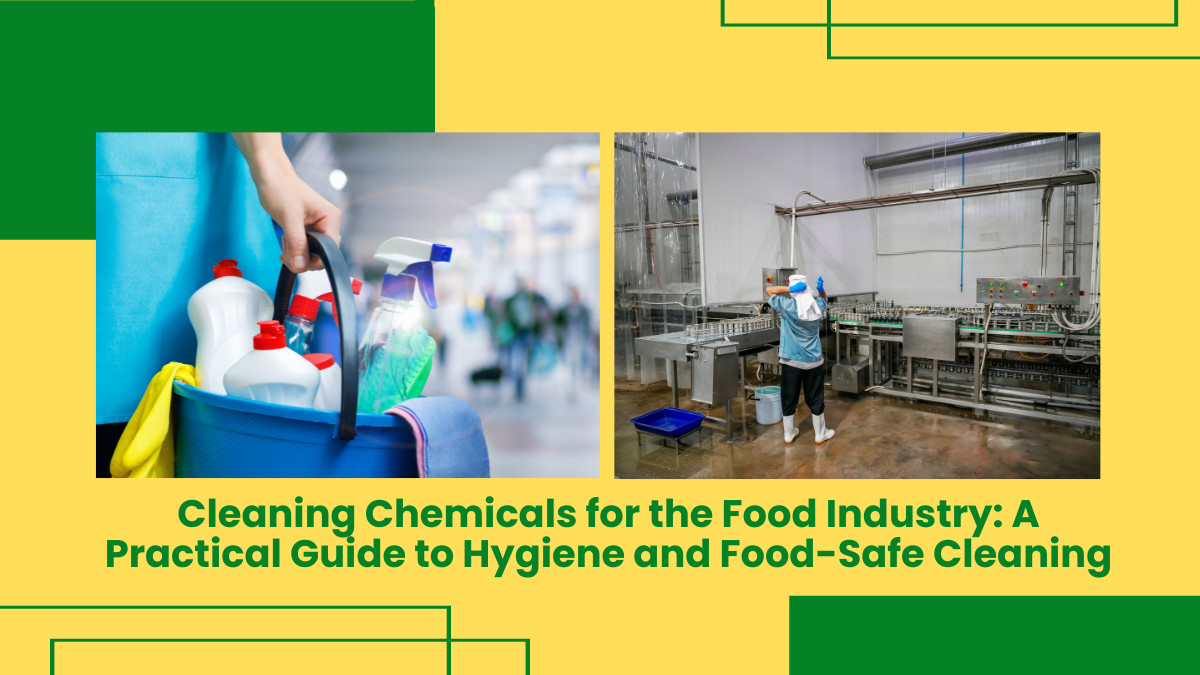
Food processing areas require a cleaning system that removes dirt, grease, food residues, and microorganisms without creating new hygiene risks. Floors, processing equipment, work surfaces, drains, storage areas, and utensils can collect organic matter throughout the production cycle. If these residues are not removed properly, they can affect sanitation and increase the risk of contamination.
Choosing the right cleaning chemicals for food industry is therefore part of maintaining a safe and hygienic production environment. Food manufacturers need products that suit the type of soil, surface, cleaning method, and production area.
This guide explains common cleaning problems in food facilities, practical solutions, and prevention tips for maintaining better food plant hygiene.
Why Food Industry Cleaning Requires the Right Chemicals
Food manufacturing facilities deal with different types of residues. Oils and fats may be present in meat, dairy, and processed-food facilities, while starch, proteins, sugars, and sauces can build up around production equipment.
Ordinary household cleaners may not be suitable for these conditions. Food industry cleaning chemicals are selected according to the cleaning requirement, surface material, application method, and type of residue.
A practical cleaning program should consider:
- Type of food residue
- Surface and equipment material
- Soil level and buildup
- Cleaning temperature
- Manual or automated cleaning method
- Required contact time
- Rinsing requirements
- Frequency of cleaning
The objective is to remove residues effectively while maintaining suitable hygiene conditions for food production areas.
Problems in Food Processing Cleaning
1. Food Residue and Organic Soil Buildup
Food residues can stick to equipment, floors, walls, tables, conveyors, and other surfaces. Protein, oil, grease, starch, and sugar deposits can become harder to remove when they remain on surfaces for long periods.
In production areas, dried residues may require more mechanical action or a suitable chemical formulation to loosen them.
Solution
Select food processing cleaning chemicals according to the type of residue.
For example:
- Alkaline cleaners can be useful for many grease and organic residues.
- Degreasers can help remove oily and greasy deposits.
- General-purpose cleaners can be used for suitable hard surfaces.
- Acidic cleaners may be required for certain mineral deposits and scale.
The cleaning chemical should always be used according to its label directions, recommended concentration, surface compatibility, and rinsing requirements.
2. Grease and Oil on Food Processing Equipment
Grease can accumulate around machinery, production lines, floors, drains, and maintenance areas. If cleaning is delayed, oily deposits can become difficult to remove.
This is particularly relevant in facilities handling edible oils, dairy products, meat products, sauces, and other products containing fats.
Solution
Use suitable industrial food cleaning chemicals that are formulated for the type of grease and surface being cleaned.
A practical process may include:
- Remove loose food debris.
- Apply the selected cleaning solution at the recommended dilution.
- Allow the required contact time.
- Use suitable mechanical action where required.
- Rinse thoroughly when the product instructions require rinsing.
- Inspect the cleaned surface before production resumes.
The exact chemical concentration and cleaning method should be established through the facility’s sanitation procedures and product instructions.
3. Cleaning Different Surfaces With One Product
Food plants contain stainless steel equipment, tiles, concrete floors, plastic components, painted surfaces, glass, and other materials. A chemical suitable for one surface may not be suitable for another.
Incorrect chemical selection can lead to surface damage, residue, discolouration, or ineffective cleaning.
Solution
Create a surface-based cleaning schedule.
For each area, record:
- Surface type
- Soil type
- Recommended cleaning chemical
- Dilution
- Application method
- Contact time
- Rinsing requirement
- Cleaning frequency
This makes it easier for cleaning teams to select the correct food factory cleaning chemicals for each application.
Solutions for Effective Food Plant Cleaning
1. Follow a Soil-Specific Cleaning Program
There is no single cleaning chemical that is ideal for every food processing application.
Start by identifying the soil.
| Soil Type | Common Cleaning Approach |
|---|---|
| Grease and oils | Suitable alkaline cleaner or degreaser |
| Protein residues | Suitable alkaline cleaning formulation |
| Starch and food residues | Appropriate detergent-based cleaner |
| Mineral scale | Suitable acidic cleaner where compatible |
| General surface dirt | General-purpose food-area cleaner |
The selection should also consider the surface material and the manufacturer’s instructions.
2. Use the Correct Dilution
Using more chemical does not necessarily produce better cleaning results. Excess chemical can increase rinsing requirements, leave residues, and raise operating costs.
Using too little can result in poor soil removal.
Cleaning teams should use measuring equipment and documented dilution instructions rather than estimating quantities manually.
3. Allow Suitable Contact Time
Cleaning chemicals need sufficient time to work on the soil. Removing the chemical immediately after application may reduce cleaning performance.
Contact time depends on the formulation, soil type, temperature, concentration, and application method. Always follow the product’s technical instructions.
4. Combine Chemical Action With Mechanical Cleaning
Chemical cleaning and physical cleaning work together.
Depending on the application, mechanical action may include:
- Scrubbing
- Brushing
- Pressure washing
- Foaming
- Manual wiping
- Automated cleaning systems
The selected method should suit the equipment and surface to avoid damage.
5. Rinse Food-Contact Surfaces Properly
Where a cleaning product requires rinsing, food-contact surfaces should be rinsed according to the product instructions before production starts.
The objective is to prevent unwanted chemical residues from remaining on surfaces that come into contact with food or food-processing equipment.
Choosing Food Industry Cleaning Chemicals
When selecting cleaning chemicals for food industry applications, purchasing teams should look beyond price.
Consider these factors:
Cleaning Performance
The product should match the type of soil found in the facility.
Surface Compatibility
Check whether the chemical is suitable for stainless steel, plastic, concrete, tiles, or other surfaces used in the facility.
Application Method
A product used for manual cleaning may have different requirements from one intended for foam cleaning, spray application, or other systems.
Safety Information
Review the product label, Safety Data Sheet, handling instructions, dilution requirements, storage conditions, and personal protective equipment requirements.
Rinsing Requirements
Determine whether the product requires rinsing and establish the appropriate procedure for food-contact applications.
Environmental Considerations
Where relevant, facilities can consider formulations and cleaning programs that reduce unnecessary chemical use, water consumption, and waste while still meeting sanitation requirements.
Prevention Tips for Food Processing Facilities
Good sanitation depends on consistent procedures rather than occasional deep cleaning.
1. Create Area-Wise Cleaning Schedules
Divide the facility into zones such as:
- Processing areas
- Food-contact surfaces
- Floors
- Walls
- Drains
- Storage areas
- Equipment exteriors
- Washrooms and staff areas
- Waste handling areas
Specify cleaning frequency for each zone.
2. Train Cleaning Staff
Employees should understand:
- Correct chemical dilution
- Safe chemical handling
- Required PPE
- Contact time
- Cleaning sequence
- Rinsing procedures
- Equipment-specific cleaning methods
- Chemical storage
Training reduces errors and improves consistency between shifts.
3. Prevent Cross-Contamination
Cleaning tools should be managed according to the facility’s hygiene zoning system.
Separate tools may be required for different areas to reduce the possibility of transferring contamination from drains, waste areas, floors, or other lower-hygiene zones to food-contact areas.
4. Inspect Cleaning Results
Visual inspection should be part of routine sanitation checks. Depending on the facility’s food safety program, additional verification methods may also be used.
Keep records of:
- Date and time of cleaning
- Area cleaned
- Chemical used
- Dilution
- Employee responsible
- Inspection result
- Corrective action, if required
5. Store Chemicals Correctly
Cleaning chemicals should be stored in designated areas away from food, packaging materials, and ingredients.
Keep containers properly labelled and follow the manufacturer’s storage instructions. Never transfer chemicals into unlabelled containers.
Ecochem Cleaning Solutions for Food Industry Applications
Ecochem manufactures industrial and commercial cleaning chemicals for different cleaning requirements. Its range includes solutions for degreasing, floor cleaning, general cleaning, toilet cleaning, dishwashing, and other facility hygiene applications.
For food-processing facilities, chemical selection should be based on the specific cleaning problem, surface, residue, application method, and sanitation procedure.
Businesses can evaluate suitable Ecochem products for areas such as:
- Food processing floors
- Production-area surfaces
- Grease and oil removal
- General facility cleaning
- Dishwashing applications
- Washroom and support-area cleaning
For food-contact surfaces and processing equipment, always verify the product’s intended application, technical documentation, dilution instructions, and rinsing requirements before use.
Final Takeaway
Effective food plant cleaning requires more than selecting a strong chemical. Facilities need the right combination of chemical selection, dilution, contact time, mechanical action, rinsing, employee training, and documented procedures.
By selecting suitable cleaning chemicals for the food industry and matching them to specific soils and surfaces, food manufacturers can maintain cleaner production areas and support their overall hygiene program.
FAQ’S
What are cleaning chemicals for the food industry?
They are cleaning formulations selected for removing food residues, grease, oils, dirt, and other soils from suitable surfaces in food-processing environments.
Which chemicals are commonly used for food processing cleaning?
Food facilities may use alkaline cleaners, degreasers, detergents, acidic cleaners, and other specialised formulations depending on the soil and surface.
Why is chemical dilution important in food plant cleaning?
Correct dilution helps balance cleaning performance, chemical use, rinsing requirements, surface compatibility, and safe handling.
Can the same cleaner be used on every food-processing surface?
Not necessarily. Chemical compatibility depends on the formulation and surface material. Product instructions should be checked before application.
How often should a food processing plant be cleaned?
Cleaning frequency depends on the production process, soil level, equipment, food safety plan, and facility requirements. High-use and food-contact areas generally require more frequent cleaning.
Written By: Vinny Jain