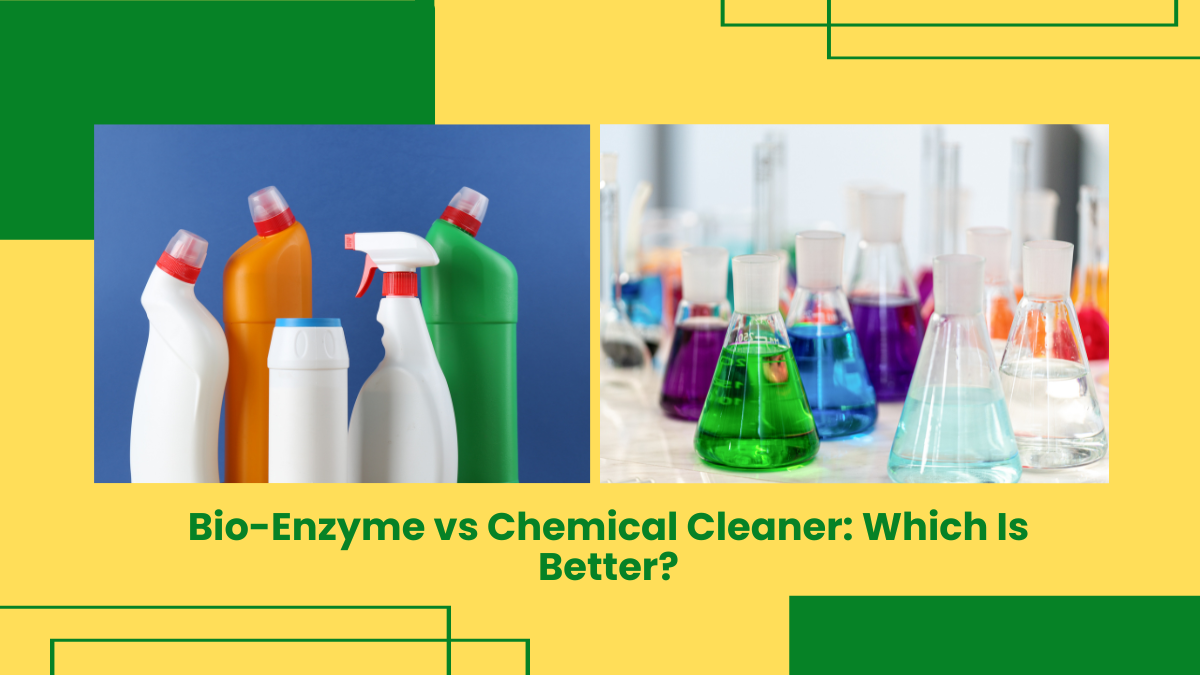
Choosing between bio-enzyme cleaning products and conventional chemical cleaners is not always a simple matter of deciding which one is “better.” Both types can have a place in commercial and industrial cleaning, but they work differently and are suited to different cleaning problems.
Bio-enzyme cleaners use enzymes and, in some formulations, microbial cultures to help break down organic soils such as food residues, grease, proteins and other odour-causing organic matter. Conventional cleaning products may use surfactants, solvents, acids, alkalis or other ingredients designed to loosen, dissolve, emulsify or remove specific types of contamination.
For factories, food-processing facilities, offices, hospitals and commercial buildings, the right choice should be based on the problem, industry, surface, contamination and cleaning process.
Bio-Enzyme vs Chemical Cleaner: What’s the Difference?
The first thing to understand is that “chemical cleaner” is a broad category. Enzymes themselves are chemicals, so the useful comparison is between enzyme-based formulations and conventional cleaning formulations.
How Bio-Enzyme Cleaners Work
Enzymes act on specific types of organic material. Different enzymes can target different soils. For example, proteases can act on protein-based residues, lipases on fats and oils, and amylases on starch-based residues.
This makes enzyme-based cleaners particularly useful where organic contamination is a recurring problem.
Ecochem’s existing bio-enzyme content describes enzyme and microbial action as a way of breaking down organic dirt, grease, stains and odour-causing material.
Bio-enzyme formulations may be useful for:
- Organic stains
- Food residues
- Grease and fat deposits
- Organic odours
- Washroom maintenance
- Drain and waste-related applications
- Routine maintenance cleaning
How Conventional Chemical Cleaners Work
Conventional cleaners can use different mechanisms depending on their formulation.
For example:
- Alkaline cleaners can help remove grease, fats and organic soils.
- Acidic cleaners can help remove mineral deposits and scale.
- Surfactant-based cleaners help loosen and suspend dirt and oils.
- Solvent-based formulations can be useful for certain oils, adhesives, or industrial residues.
- Disinfectants are formulated to reduce or kill microorganisms according to their intended use and instructions.
This range makes conventional cleaners useful when a facility needs a specific cleaning action.
The question is therefore not simply bio-enzyme vs chemical cleaner. The better question is:
Which cleaner is appropriate for this contamination, surface and application?
What Problems Should You Consider First?
Before choosing a cleaner, identify what is actually causing the cleaning problem.
Organic Residue
Food, fats, proteins, body soils and other organic materials can be suitable targets for enzyme-based cleaning.
Heavy Grease and Industrial Soil
Factories and workshops may deal with machinery oils, lubricants, heavy grease and accumulated industrial grime.
These applications can require a dedicated industrial degreaser rather than relying on an enzyme-based product alone.
Mineral Deposits
Hard-water scale, lime deposits and mineral stains are different from organic soils.
An appropriate acidic cleaner or descaler may be more suitable for these applications.
General Dirt
Dust, fingerprints and everyday soil on office or commercial surfaces may only require a suitable multipurpose cleaner.
The cleaner should match the actual problem rather than simply being selected because it is labelled “green” or “heavy duty.”
Which Industries Can Use Bio-Enzyme Cleaning Products?
Different industries can benefit from enzyme-based cleaning, but the application needs to be evaluated carefully.
Food Processing
Food-processing facilities regularly encounter organic residues such as fats, proteins, starches and food particles.
Bio-enzyme cleaning products may be useful for selected maintenance applications involving organic soil. However, food manufacturers should not assume that every enzyme cleaner is automatically suitable for food-contact surfaces.
The product’s intended application, formulation, manufacturer instructions and the plant’s food-safety programme must be checked before use.
Commercial Offices
Offices generally have lighter cleaning requirements than manufacturing plants.
Enzyme-based products can be considered for suitable applications involving organic stains, odours and routine maintenance.
For desks, glass, floors and general surfaces, the appropriate cleaner should be selected according to the material and type of dirt.
Hospitals and Healthcare Facilities
Healthcare cleaning requires a controlled approach because cleaning and disinfection have different purposes.
An enzyme cleaner may help remove organic soil in certain applications, but it should not automatically be treated as a disinfectant.
Where disinfection is required, the facility should use an appropriate disinfectant according to its infection-control procedures.
Hospitality and Housekeeping
Hotels, commercial kitchens, restaurants and housekeeping operations deal with food residues, grease, odours, washroom deposits and general dirt.
A combination of cleaning products can be more practical than relying on a single formulation.
Manufacturing Plants
Manufacturing facilities often have multiple contamination types within the same building.
For example:
Production area: oil, grease and process residue
Maintenance area: lubricants and heavy industrial grime
Office: dust and general dirt
Washroom: mineral deposits, soap residue and organic contamination
This is where a planned combination of cleaners can make more sense than choosing one category for the entire facility.
When Should You Choose Bio-Enzyme Cleaners?
Consider bio-enzyme cleaning products when the main problem involves organic contamination and the product is designed for that particular application.
They can be useful where facilities want to address:
- Organic residues
- Food-related soils
- Persistent organic odours
- Routine maintenance cleaning
- Certain washroom applications
- Selected drain or waste-area applications
Enzyme cleaners can require sufficient contact time because the enzymes need an opportunity to act on the target material. Ecochem’s existing guidance also recommends following the stated dilution, allowing adequate working time and avoiding incompatible harsh chemicals that could interfere with the biological formulation.
When Are Conventional Chemical Cleaners Better?
Conventional cleaners can be the more practical choice when the facility has a specific heavy-duty cleaning requirement.
Heavy Industrial Grease
Manufacturing equipment may accumulate mineral oils, lubricants and heavy grease. A dedicated industrial degreaser can be better suited to this type of contamination.
Ecochem’s current product information positions Eco-Green Kleen HDD as a water-based heavy-duty industrial cleaner for oil, grease and stubborn grime on compatible industrial surfaces.
Hard-Water Scale
Mineral deposits require a different cleaning mechanism. An appropriate acidic cleaner or descaler can be considered where compatible with the surface.
Rapid Cleaning Requirements
Some commercial and industrial operations have short cleaning windows. If a formulation is designed to act quickly on the target soil, it may be more practical than an enzyme-based product requiring longer contact time.
Disinfection
Cleaning and disinfection should not be treated as the same task.
An enzyme cleaner may remove organic material, but a product specifically intended and labelled for disinfection is required where microbial reduction is part of the cleaning protocol.
Can Bio-Enzyme and Conventional Cleaners Be Used Together?
Yes, but not by mixing them in the same container unless the product manufacturer specifically permits it.
In many facilities, different cleaning products can be used for different stages or areas.
For example:
Step 1: Remove loose soil.
Step 2: Use the appropriate cleaner for the contamination.
Step 3: Rinse or remove residues according to the product instructions.
Step 4: Apply a suitable disinfectant where the cleaning programme requires disinfection.
Step 5: Allow the area to dry where applicable.
The exact sequence depends on the facility and product.
For enzyme-based products, Ecochem’s own published guidance warns against mixing them with harsh chemicals because these may interfere with beneficial biological activity.
How to Choose Between Bio-Enzyme and Chemical Cleaners
A facility manager should ask six questions before buying.
1. What Are You Removing?
Identify the contamination first.
Is it:
- Grease?
- Oil?
- Food residue?
- Protein?
- Starch?
- Mineral scale?
- Dust?
- Organic odour?
- General dirt?
2. What Surface Are You Cleaning?
Consider whether the surface is:
- Stainless steel
- Aluminium
- Concrete
- Ceramic
- Marble
- Plastic
- Painted metal
- Glass
- Other sensitive material
Never assume that a cleaner suitable for one material will work safely on another.
3. How Much Cleaning Time Is Available?
If a facility has sufficient contact time, an enzyme-based cleaner may be suitable for certain organic soils.
If the cleaning window is short, another formulation may be more appropriate.
4. Is Disinfection Required?
If the objective includes microbial control, choose a product specifically intended for that purpose. Do not assume that an “eco-friendly” or enzyme-based cleaner is automatically a disinfectant.
5. What Are the Environmental Requirements?
Businesses may consider biodegradability, plant-derived ingredients, wastewater considerations, packaging and chemical consumption when comparing products.
However, environmental claims should be assessed based on the actual formulation and supporting product information rather than the word “green” alone.
6. What Is the Cost Per Cleaning?
Do not compare products only by price per litre.
Consider:
Purchase price + dilution + coverage + labour + cleaning frequency + contact time
A product with a higher purchase price may have a lower cost per application if it is used at an efficient dilution and provides suitable cleaning performance.
Bio-Enzyme vs Chemical Cleaner: Which Is Better for Your Business?
There is no universal winner.
Choose bio-enzyme cleaning products when:
- Organic contamination is the main problem
- Odour is linked to organic material
- The application suits enzyme activity
- Adequate contact time is available
- The product meets the facility’s requirements
Consider conventional chemical cleaners when:
- Heavy grease requires dedicated degreasing
- Mineral scale needs acidic cleaning
- Fast soil removal is required
- A specific industrial contaminant needs a targeted formulation
- Disinfection is required, and a suitable disinfectant is needed
For many facilities, the most practical approach is a task-based cleaning programme that uses different products for different problems.
Why Choose Ecochem for Eco-Friendly Cleaning Solutions?
Ecochem develops cleaning products for industrial and commercial applications, with its product range covering categories such as industrial cleaning, floor cleaning, multipurpose cleaning and other housekeeping requirements. Its published content also covers bio-enzyme, enzymatic and biodegradable cleaning solutions.
For example, Eco-Greener is presented by Ecochem as an acid-free multipurpose cleaner for different areas and spaces, while Eco-Green Kleen HDD is positioned for heavier industrial cleaning applications.
This allows businesses to approach cleaning according to the actual problem instead of expecting one product to handle every type of contamination.
Before selecting a bio-enzyme cleaning product or conventional cleaner, businesses should share information about the surface, soil type, cleaning frequency, application method and required outcome with the supplier.
Quick Buying Checklist
Before placing a bulk order, check:
- What type of soil needs to be removed?
- Is the contamination organic or mineral?
- What surface will be cleaned?
- Is an enzyme-based formulation appropriate?
- Is a heavy-duty chemical cleaner required?
- Is disinfection part of the process?
- What dilution is recommended?
- What contact time is required?
- Is the product compatible with the surface?
- What is the cost per application?
- What safety information is available?
- Can the supplier provide application guidance?
Final Takeaway
The bio-enzyme vs chemical cleaner decision should not be treated as a competition between “natural” and “chemical.”
The better approach is to match the cleaner with the contamination.
Organic residue → consider an enzyme-based cleaner.
Heavy industrial grease → consider a suitable degreaser.
Mineral scale → consider an appropriate descaler.
General office dirt → use a suitable multipurpose cleaner.
Microbial-control requirement → use an appropriate disinfectant.
For factories, food-processing units, offices, healthcare facilities and commercial buildings, a combination of cleaning products may provide a more practical solution than trying to replace every cleaner with one category.
Ecochem provides industrial and commercial cleaning solutions, including products positioned for green, bio-based and conventional cleaning applications. Businesses can evaluate the right product based on the surface, contamination, cleaning process and facility requirements.
FAQ’S
Is a bio-enzyme cleaner better than a chemical cleaner?
Neither is universally better. Bio-enzyme cleaners can be useful for selected organic soils, while conventional cleaners may be more suitable for heavy grease, mineral deposits or applications requiring a specific chemical action.
What are bio-enzyme cleaning products used for?
They are commonly used for suitable organic residues, food-related soils, odour-causing organic material and maintenance cleaning. Their effectiveness depends on the enzyme formulation, target soil and application conditions.
Can enzyme-based cleaners remove grease?
Some enzyme-based formulations can help with fats and grease, particularly when they contain suitable enzymes such as lipase. Heavy industrial grease may still require a dedicated degreaser.
Are bio-enzyme cleaners disinfectants?
Not automatically. A cleaner designed to break down organic soil should not be assumed to provide disinfection. Use a suitable disinfectant when the cleaning protocol requires microbial control.
Are eco-friendly cleaners suitable for factories?
Yes, suitable eco-friendly cleaners can be used in industrial facilities when their formulation, cleaning performance, surface compatibility and application requirements match the job.
Written By: Vinny Jain