Choosing industrial cleaning chemicals for hospitals requires understanding the maintenance task, surface material and product limitations. Healthcare facilities may need specialised chemicals for non-clinical maintenance tasks such as removing rust and grease from compatible metal tools or equipment. A multipurpose industrial remover should not automatically be used on medical devices, painted surfaces or patient-care areas.
Before selecting a product, facility managers should confirm its intended application, surface compatibility, handling instructions and suitability for the specific maintenance environment.
2. Why Do Healthcare Facilities Need Specialised Maintenance Chemicals?
Hospitals contain more than patient rooms and treatment areas. Engineering workshops, utility rooms, maintenance stores and service departments also need regular upkeep.
These areas may develop:
- Rust on compatible metal tools and equipment.
- Oil and grease deposits around maintenance machinery.
- Stubborn marks on metal components.
- Residue from adhesives and sealants.
- Corrosion-related maintenance concerns.
Using an unsuitable chemical can damage coatings, affect metal finishes or create additional cleaning work. Facility teams should therefore select products according to the material and the type of deposit rather than using one chemical everywhere.
3. How to Choose Industrial Cleaning Chemicals for Hospitals
Consider these five factors before purchasing a multipurpose industrial remover.
1. Identify the Cleaning Requirement
First, determine what needs to be removed.
| Cleaning requirement | Product selection consideration |
|---|---|
| Rust on metal tools | Select a product specifically intended for rust removal |
| Grease on maintenance components | Check whether the product has degreasing applications |
| Adhesive or sealant residue | Confirm that the product lists these contaminants |
| Dirt on painted surfaces | Use a paint-compatible cleaner; avoid products that may damage coatings |
| Medical equipment cleaning | Follow the equipment manufacturer’s approved cleaning instructions |
A rust remover and a routine surface cleaner are not interchangeable.
2. Check Material Compatibility
Healthcare maintenance areas may contain stainless steel, chrome, cast iron, aluminium, painted metal, plastic and coated surfaces.
A product that is suitable for one material may damage another. Check the product instructions before applying it, particularly to painted surfaces, coatings, electrical components or delicate equipment.
The CDC recommends considering product compatibility with equipment manufacturers’ instructions when selecting cleaning and disinfection products for healthcare environments. CDC+1
3. Review Dilution and Application Instructions
Check the manufacturer’s instructions for:
- Recommended dilution ratio.
- Application method.
- Contact time, where specified.
- Rinsing or residue-removal requirements.
- Required protective equipment.
Do not increase the concentration to improve cleaning performance unless the manufacturer confirms that it is appropriate.
4. Separate Maintenance Cleaning from Clinical Cleaning
An industrial remover intended for metal maintenance should not automatically be used on:
- Medical instruments and devices.
- Patient beds and examination surfaces.
- ICU monitors and electronic equipment.
- Patient-contact surfaces.
- Surfaces requiring a validated disinfection procedure.
Medical equipment manufacturers provide specific cleaning and maintenance instructions. Healthcare teams should follow those instructions and the hospital’s infection-control SOP. CDC+1
5. Consider Staff Safety and Residue
Review the product label and safety information before introducing a chemical into a maintenance area. Confirm ventilation requirements, protective equipment, storage and disposal instructions.
Also establish whether the product requires rinsing or another residue-removal step before the cleaned item is returned to service.
4. Practical Procedure for Using an Industrial Remover
A controlled procedure helps maintenance teams avoid unnecessary surface damage.
- Inspect the item: Identify the metal type, coating and contamination.
- Check product suitability: Confirm that the product is intended for the material and cleaning task.
- Prepare the area: Keep unrelated equipment and materials protected.
- Prepare the solution: Follow the manufacturer’s dilution instructions.
- Apply as directed: Use the specified application method and contact time.
- Remove residue: Follow the product’s rinsing or wiping instructions.
- Inspect the surface: Check for remaining rust, grease, damage or residue before returning the item to service.
Do not apply chemicals to electrical components or medical equipment unless the relevant manufacturer specifically permits it.
5. How Eco-All In One May Fit Healthcare Maintenance
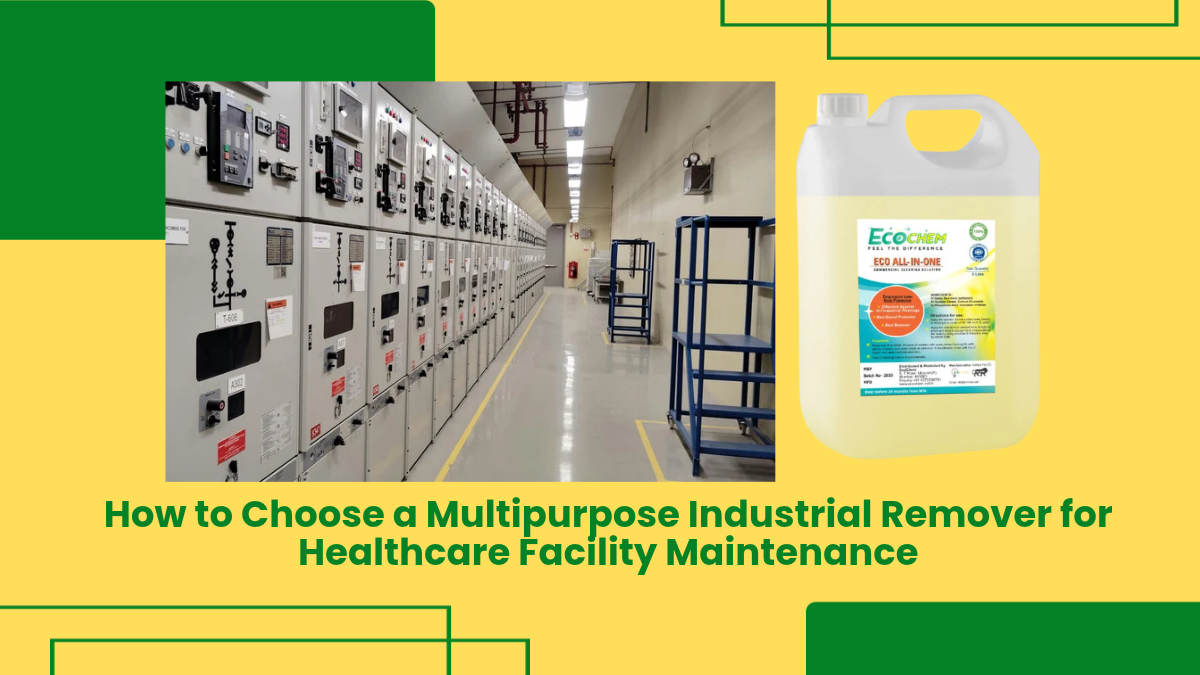
Eco-All In One is listed by Ecochem as a multipurpose industrial remover. Its product page describes applications involving rust removal, degreasing and rust protection on specified metal surfaces. It mentions tools, metal, cast iron and chrome parts, and describes a phosphate layer intended to provide rust protection. The listed dilution ratio is 10 ml in 1 litre of water. Ecochem
The product page also states that:
- It should not be used on painted surfaces because it may damage the paint.
- It is listed for removing adhesives, sealants, oil and grease in industrial settings.
- Its suitability for a particular surface should be confirmed before use. Ecochem
For healthcare facilities, Eco-All In One may be evaluated for compatible, non-clinical metal maintenance tasks, such as cleaning suitable tools or metal components. Its use should be confirmed with Ecochem before adding it to a hospital maintenance SOP.
Important: The product page does not establish approval for medical devices, patient-care surfaces or hospital disinfection. Its stated industrial applications should not be interpreted as approval for clinical use.
6. Common Mistakes to Avoid
- Using an industrial remover on painted surfaces.
- Assuming every metal or coating is compatible.
- Applying the product to medical devices without manufacturer approval.
- Increasing the dilution concentration without guidance.
- Ignoring product handling and residue-removal instructions.
- Mixing the remover with other cleaning chemicals.
- Treating rust removal as a substitute for preventive equipment maintenance.
7. Prevention Tips for Hospital Maintenance Teams
- Inspect metal tools and equipment regularly for early signs of rust.
- Address oil and grease leaks at their source.
- Store maintenance chemicals in labelled containers.
- Train staff on dilution, application and handling instructions.
- Maintain separate procedures for clinical and non-clinical areas.
- Record recurring corrosion or contamination for maintenance follow-up.
8. Frequently Asked Questions
What are industrial cleaning chemicals used for in hospitals?
They support non-clinical maintenance tasks such as removing grease and rust from compatible tools and metal components.
What is a multipurpose industrial remover?
It is a specialised cleaning product intended for multiple industrial contaminants, depending on its verified applications and surface compatibility.
Can industrial removers be used on medical equipment?
Not automatically. Follow the medical equipment manufacturer’s cleaning instructions and confirm chemical compatibility before use.
Can Eco-All In One be used on painted surfaces?
No. Ecochem’s product page specifically advises against using Eco-All In One on painted surfaces because it may damage paint.
What is the dilution ratio of Eco-All In One?
Ecochem lists 10 ml in 1 litre of water. Follow the current product label and confirm application instructions before use.
Written By: Vinny Jain