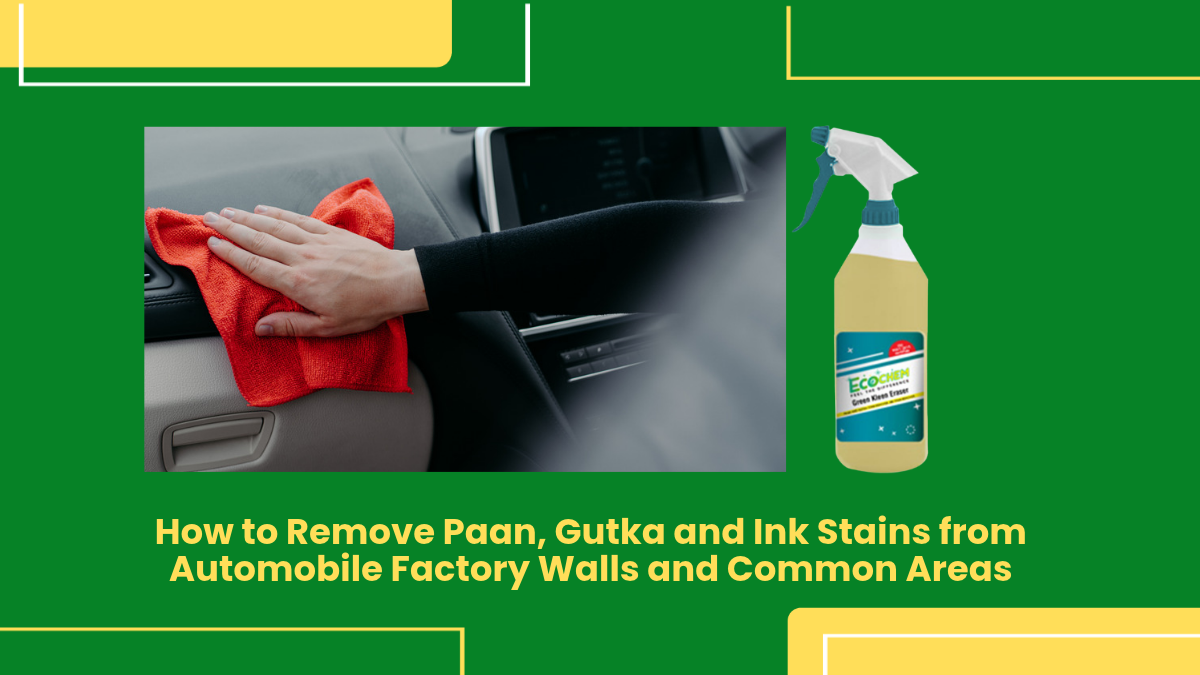
Paan, gutka, and ink stains can make automobile factory walls, staircases, corridors and employee common areas look poorly maintained. Removing these marks requires identifying the stain, checking the wall material and choosing a suitable stain remover for automobile manufacturing plants.
Automobile facilities may have painted walls, concrete surfaces, tiles, metal grills and coated partitions. A cleaning chemical that works on one surface may affect the finish of another. Housekeeping teams should therefore follow product instructions, test a small area and use the correct application method.
Why Paan, Gutka and Ink Stains Are a Challenge in Automobile Factories
Factory common areas experience regular movement from employees, contractors and visitors. Stains may appear around entrances, staircases, washroom walls, corridors and designated break areas.
Common types include:
- Paan stains: Red or brown marks caused by paan residue and spitting.
- Gutka stains: Dark or reddish marks that may become difficult to remove when left untreated.
- Ink stains: Marks from pens, markers, labels and accidental writing.
- Paint stains: Splashes or marks created during maintenance and facility work.
If these stains are not addressed promptly, repeated cleaning may become more difficult, particularly on porous or textured walls.
How to Choose a Stain Remover for Automobile Manufacturing Plants
Before purchasing an industrial stain remover, facility managers should evaluate three important factors.
1. Identify the stain type
Different stains may require different cleaning approaches. A product intended for paan and gutka marks should not automatically be assumed suitable for every type of ink, paint or chemical residue.
Check the product’s stated applications and select it according to the actual stain.
2. Check the wall material and finish
Automobile manufacturing facilities may have:
- Painted plaster walls
- Concrete walls
- Ceramic tiles
- Metal grills and partitions
- Coated surfaces
- Plastic panels
Painted walls need particular attention because some cleaning chemicals can soften paint, remove colour or affect the coating. Always check compatibility and test an inconspicuous area before treating a larger section.
3. Review dilution and handling instructions
A suitable stain remover should have clear instructions covering dilution, application, waiting time, rinsing and protective equipment.
Housekeeping supervisors should also review the product label and Safety Data Sheet (SDS), where available. Never increase the concentration or mix the product with other cleaning chemicals to achieve faster results.
Practical Steps to Remove Paan, Gutka and Ink Stains
Follow a consistent cleaning procedure for approved wall and common-area surfaces.
Step 1: Inspect the stained area
Identify the stain and check whether the wall has paint, coating, tiles or another finish.
Step 2: Remove loose dirt
Wipe away loose dust using a clean cloth. Avoid aggressive rubbing because it may spread the stain or damage the surface.
Step 3: Test the cleaning product
Apply the recommended solution to a small, hidden section. Check for colour changes, paint removal or surface damage before proceeding.
Step 4: Prepare the solution
Follow the manufacturer’s specified dilution. Use an appropriate measuring container rather than estimating the quantity.
Step 5: Apply the stain remover
Use the application method and waiting time specified on the product label. Avoid unnecessary spraying near electrical equipment, machinery or people.
Step 6: Rinse and inspect
Rinse with water if instructed. Check whether the stain has been removed and whether the wall finish remains intact.
Step 7: Record recurring stains
Include frequently affected locations in the housekeeping checklist. Report repeated staining or damaged wall coatings to the facility team.
Prevention Tips for Automobile Factory Common Areas
Removing existing stains is only one part of facility maintenance. Preventive housekeeping can reduce recurring cleaning work.
- Inspect corridors, staircases and common areas regularly.
- Clean fresh stains promptly using approved cleaning procedures.
- Display workplace notices discouraging spitting in public areas.
- Include wall inspections in daily housekeeping checklists.
- Train housekeeping staff in chemical handling and surface compatibility.
- Keep cleaning materials separate according to the facility’s housekeeping policy.
- Arrange repainting or surface repairs where stains have penetrated damaged coatings.
How Eco-Green Kleen Eraser Fits into Automobile Factory Cleaning
Eco-Green Kleen Eraser by Ecochem is listed as a stain remover for paan, gutka, ink and paint marks. Its official product page identifies industrial walls, grills and corners as intended applications. Ecochem
The published product information specifies:
- Product: Eco-Green Kleen Eraser
- Listed dilution ratio: 10 ml in 1 litre of water
- Described application: Spray onto the stain, leave for 5–10 minutes and wash with normal water
- Precaution: Ecochem recommends wearing rubber gloves because direct handling with bare hands may cause itching. Ecochem+1
Automobile manufacturing facilities can evaluate this product for suitable paan, gutka, ink and paint-stain removal on compatible industrial walls and common-area surfaces.
Important: The product page describes both a diluted ratio and a spray application. Confirm the current product label for the correct preparation and application method before use. Do not assume compatibility with every painted wall, automotive coating, vehicle body or precision component.
Explore Eco-Green Kleen Eraser – Paan, Gutka and Ink Stain Remover for product information.
Common Mistakes to Avoid
- Using the same stain remover on painted walls, tiles and metal without checking compatibility.
- Scrubbing aggressively and damaging wall paint.
- Applying concentrated chemicals without following product instructions.
- Leaving the cleaning solution on the surface longer than specified.
- Mixing stain removers with bleach or other chemicals.
- Assuming stain removal also disinfects the surface.
- Ignoring recurring stains instead of addressing the source.
Conclusion
Removing paan, gutka and ink stains from automobile factory walls requires correct stain identification, compatible cleaning chemicals and a consistent housekeeping procedure. Regular inspections and prompt cleaning can help maintain corridors, staircases and employee common areas.
Ecochem’s Eco-Green Kleen Eraser is listed for paan, gutka, ink and paint-stain removal on industrial walls, grills and corners. Automobile facility managers can review its product details and contact Ecochem to confirm suitability for their specific surfaces.
Frequently Asked Questions
How can paan stains be removed from automobile factory walls?
Use a suitable stain remover according to its instructions. Test a hidden area first to check wall-finish compatibility.
Which cleaner removes gutka stains from industrial walls?
Choose a product specifically listed for gutka stains and compatible with the wall material and coating.
Can ink stains be removed from painted factory walls?
They may be removable, depending on the ink and paint. Test first to avoid colour fading or coating damage.
What is the dilution ratio of Eco-Green Kleen Eraser?
Ecochem lists 10 ml in 1 litre of water. Confirm the current product label for preparation and application instructions.
How long should Eco-Green Kleen Eraser remain on a stain?
The product page describes a 5–10-minute waiting period. Follow the current label and confirm surface compatibility.