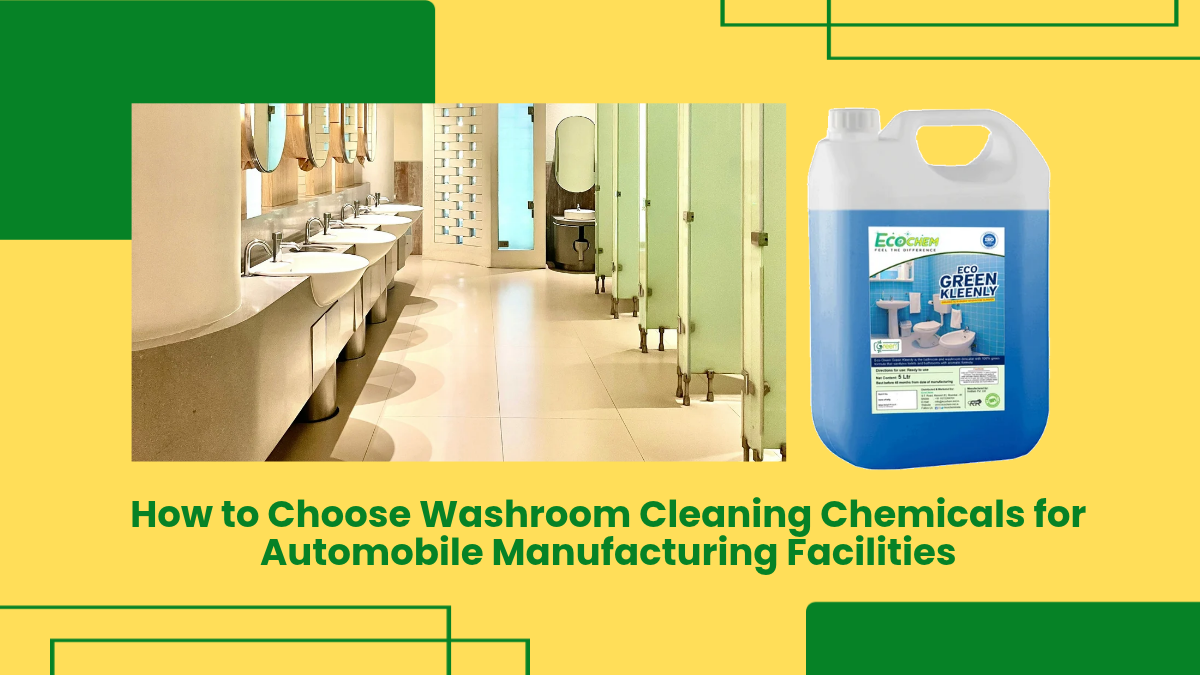
Automobile manufacturing facilities need a regular washroom cleaning routine to maintain clean and presentable employee facilities. Choosing suitable washroom cleaning chemicals for the automobile industry involves checking the type of stains, surface materials, product formulation and application instructions.
Factory washrooms are used by production workers, supervisors, visitors and administrative staff. They may develop soap deposits, hard-water marks, unpleasant odours and dirt around toilets, washbasins and floor corners. A suitable washroom cleaner can support routine cleaning, while separate procedures may be needed for disinfection and specialised stain removal.
Common Washroom Cleaning Challenges in Automobile Factories
Automobile plants often operate across multiple shifts, which means washrooms can experience frequent use throughout the working day.
Common cleaning challenges include:
- Hard-water deposits: Mineral deposits can develop around taps, washbasins and toilet fixtures.
- Soap and dirt buildup: Repeated use can leave deposits on ceramic surfaces, tiles and washbasins.
- Oil and grease marks: Workers may carry traces of workshop dirt into common washroom areas.
- Unpleasant odours: Inadequate cleaning, poor ventilation and drainage issues can contribute to persistent smells.
- High-touch surfaces: Door handles, taps, flush handles and other frequently touched points need regular attention.
A planned cleaning schedule helps housekeeping teams manage these issues without using the same chemical for every surface.
How to Choose Washroom Cleaning Chemicals for the Automobile Industry
Before selecting a washroom cleaner, facility managers should evaluate the following factors.
1. Identify the type of cleaning requirement
First, identify the main contamination in the washroom.
| Cleaning requirement | What to consider |
|---|---|
| Soap deposits and general dirt | A suitable routine washroom cleaner |
| Hard-water marks | A product labelled for mineral deposit removal |
| Oil and grease stains | A cleaner approved for the specific stain and surface |
| Toilet bowl deposits | A toilet cleaner compatible with the bowl material |
| Odour concerns | Cleaning, drainage inspection and ventilation |
A washroom cleaner should not automatically be treated as an industrial degreaser or disinfectant.
2. Check surface compatibility
Automobile factory washrooms may contain ceramic toilet bowls, glazed tiles, stainless-steel fittings, plastic accessories, glass and natural stone.
Check the product label before applying a chemical to these surfaces. Acid-based cleaners, in particular, may damage marble, natural stone and certain sensitive materials. Use a separate product where the surface manufacturer recommends one.
3. Review chemical formulation and dilution
Check whether the product is suitable for the intended washroom cleaning task. Review its formulation, dilution ratio, application instructions and safety information.
A product’s concentration should never be guessed. Incorrect dilution may affect cleaning performance and increase unnecessary chemical exposure.
4. Consider housekeeping staff safety
Cleaning teams should understand how to prepare, apply and store the selected chemical. Check the Safety Data Sheet (SDS), provide the required personal protective equipment and maintain suitable ventilation.
Never mix different cleaning chemicals. Incompatible products can release hazardous gases or cause dangerous reactions. OSHA+1
Practical Washroom Cleaning Procedure for Automobile Facilities
A standard procedure helps maintain consistency across different shifts.
- Prepare the washroom: Display cleaning-in-progress signs and restrict access where necessary.
- Remove visible waste: Empty bins and remove loose dirt before wet cleaning.
- Prepare the cleaning solution: Follow the product label and use the specified dilution.
- Clean toilets and washbasins: Use an appropriate cleaner and dedicated cleaning tools for each fixture.
- Clean high-touch points: Pay attention to taps, flush handles, door handles and switches using products approved for those surfaces.
- Clean floors: Remove dirt and spills using a suitable floor-cleaning method.
- Rinse where required: Follow the product’s instructions and avoid leaving unwanted chemical residue.
- Inspect and record: Check the washroom, replenish supplies and update the housekeeping checklist.
Use separate or colour-coded cloths and brushes according to the facility’s cleaning policy. Do not use toilet-cleaning equipment on washbasins or other fixtures.
Cleaning and Disinfection Are Different
Cleaning removes dirt, deposits and other visible soil. Disinfection uses a product with validated antimicrobial activity to reduce or inactivate specified microorganisms when used according to its instructions.
A washroom cleaner should not automatically be considered a disinfectant. If the automobile facility requires disinfection of particular surfaces, select an appropriate product with verified efficacy and follow its label instructions. The CDC also recommends regular attention to high-touch surfaces in shared facilities. CDC+1
How Eco-Green Kleenly Fits into Automobile Factory Washroom Cleaning
Ecochem’s Eco-Green Kleenly is a biotic acid-based washroom and bathroom cleaner. Its official product page describes it for washroom cleaning and lists the removal of oil, grease and paint stains. The page states a dilution ratio of 10 ml in 1 litre of water. Ecochem
Automobile manufacturing facilities can evaluate Eco-Green Kleenly for compatible washroom cleaning applications after reviewing its product instructions. Since it is acid-based, users should confirm compatibility before applying it to natural stone, sensitive metals, coatings or other acid-sensitive surfaces.
The product page’s sanitising and broad safety claims should not be interpreted as proof of a specific disinfectant efficacy or approval for every washroom surface.
Explore Eco-Green Kleenly Washroom and Bathroom Cleaner for product information.
Common Mistakes to Avoid
- Using the same cleaner on every washroom surface.
- Applying acid-based products to marble without checking compatibility.
- Guessing chemical dilution ratios.
- Mixing toilet cleaners with bleach or other chemicals.
- Ignoring taps, flush handles and door handles during cleaning.
- Reusing contaminated cleaning cloths.
- Skipping cleaning schedules and inspection records.
Conclusion
Selecting suitable washroom cleaning chemicals for the automobile industry requires attention to stains, surface compatibility, chemical formulation and staff safety. A planned cleaning procedure helps automobile factories maintain employee washrooms across different shifts.
Ecochem’s Eco-Green Kleenly is a biotic acid-based washroom cleaner with a stated dilution ratio of 10 ml per litre of water. Facility managers can review its product information and contact Ecochem to confirm suitability for their washroom cleaning requirements.
Frequently Asked Questions
Which cleaning chemicals are suitable for automobile factory washrooms?
Choose products according to the surface, stain type and cleaning requirement. Check the product label before use.
How often should automobile factory washrooms be cleaned?
Set cleaning frequency according to employee usage, shift patterns, visible soiling and the facility’s housekeeping schedule.
Can washroom cleaners remove oil and grease stains?
Some washroom cleaners are formulated for specific oil and grease stains. Confirm the product’s stated applications and surface compatibility.
What is the dilution ratio of Eco-Green Kleenly?
Ecochem lists 10 ml in 1 litre of water. Always follow the current product label and application instructions.
Can acid-based washroom cleaners be used on marble?
Avoid using acid-based cleaners on marble unless the stone and product manufacturers explicitly confirm compatibility.