Hospital washrooms require regular cleaning because patients, visitors and healthcare staff use these facilities throughout the day. Choosing the right hospital washroom cleaning chemicals involves checking the type of dirt, surface compatibility, cleaning requirements and staff safety. Hospitals should also maintain a separate disinfection procedure wherever infection-control protocols require it.
A suitable washroom cleaner helps remove visible dirt, grease and deposits from compatible surfaces. However, a general washroom cleaner should not automatically be treated as a disinfectant.
Why Is Washroom Cleaning Important in Hospitals?
Hospital washrooms are frequently used and can become contaminated through regular contact with hands, water, bodily fluids and everyday waste.
Common cleaning challenges include:
- Soap scum and mineral deposits around sinks and taps.
- Grease and stubborn stains on compatible surfaces.
- Dirt accumulation around toilet bowls and floor corners.
- Watermarks on ceramic fittings and washroom fixtures.
- Frequent contamination of door handles, taps and toilet seats.
The CDC identifies patient-area toilets as higher-risk areas because they receive frequent exposure and contamination. Its guidance recommends cleaning and disinfecting private patient toilets at least daily and public or shared toilets at least twice daily, with additional cleaning when required. CDC+1
How to Choose the Right Hospital Washroom Cleaning Chemicals
Before selecting a product, facility managers should assess the following factors.
1. Identify the Type of Stain
Different deposits may require different cleaning approaches.
- Soap scum: Select a cleaner suitable for soap residue and compatible bathroom surfaces.
- Grease and oily marks: Choose a product whose stated applications include grease removal.
- Hard-water deposits: Check whether the product is designed for mineral or scale removal.
- General dirt: Use a suitable routine washroom cleaner for everyday maintenance.
Avoid selecting a chemical only because it is labelled as a bathroom cleaner. Check its intended applications and instructions.
2. Check Surface Compatibility
Hospital washrooms may contain ceramic tiles, glazed surfaces, stainless steel fittings, chrome taps, plastic accessories and natural stone.
A chemical suitable for one surface may damage another. Acid-based cleaners, in particular, require caution around marble, limestone and acid-sensitive metals.
Always check the product label, manufacturer instructions and surface compatibility before use. Test on a small, inconspicuous area where appropriate.
3. Review Dilution and Application Instructions
Correct dilution helps housekeeping teams maintain consistent cleaning practices and avoid unnecessary chemical use.
Check the recommended dilution, application method, contact time, rinsing requirements and personal protective equipment instructions. Staff should never estimate chemical quantities or mix cleaning products.
4. Separate Cleaning from Disinfection
Cleaning removes visible dirt and organic matter. Disinfection is a separate process intended to inactivate specified microorganisms when the product is approved and used according to its instructions.
Hospitals should use facility-approved disinfectants for surfaces and areas requiring disinfection. A general washroom cleaner should not replace that procedure. CDC+1
Practical Washroom Cleaning Procedure for Healthcare Facilities
A written cleaning checklist helps housekeeping teams follow a consistent process.
- Prepare the area: Display wet-floor signs, arrange cleaning materials and wear the required protective equipment.
- Remove visible waste: Clear bins and dispose of waste according to hospital procedures.
- Clean surfaces: Clean sinks, taps, counters, toilet exteriors and other compatible surfaces using the appropriate chemical.
- Clean toilet areas: Follow the facility’s designated toilet-cleaning procedure and use separate cleaning equipment where required.
- Disinfect where necessary: Apply the facility-approved disinfectant to the specified surfaces, following its contact time.
- Clean floors: Work from cleaner areas towards dirtier areas and finish near the exit.
- Inspect and record: Check for missed areas, refill supplies and record the completed cleaning task.
Cleaning frequency should reflect washroom usage, contamination and hospital policy. Shared patient and visitor toilets generally need more frequent attention than low-use areas. CDC+1
How Eco-Green Kleenly Fits Hospital Washroom Cleaning
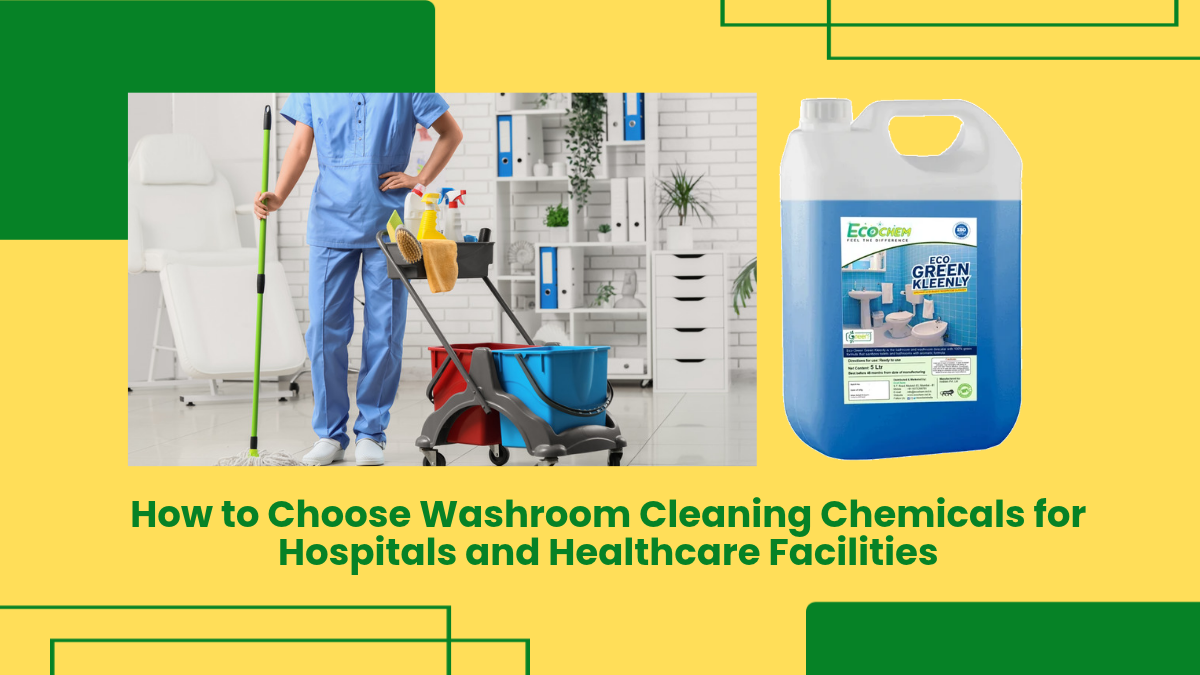
Eco-Green Kleenly is listed on Ecochem’s website as a washroom and bathroom cleaner. The product page describes it as a biotic acid-based formulation intended to help remove tough oil, grease and paint stains without leaving residue. Its stated dilution ratio is 10 ml in 1 litre of water. Ecochem
For healthcare facility managers considering this product, the important checks are:
- Confirm that the surface is compatible with an acid-based cleaner.
- Follow the stated dilution and product instructions.
- Check the label for handling, protective equipment and rinsing guidance.
- Confirm suitability for the specific washroom task before introducing it into the hospital cleaning SOP.
The product page does not establish hospital-grade disinfection efficacy. Therefore, Eco-Green Kleenly should not be treated as a replacement for a facility-approved disinfectant.
Common Mistakes to Avoid
- Using the same chemical on every washroom surface.
- Applying concentrated products without checking dilution instructions.
- Mixing different cleaning chemicals.
- Ignoring protective equipment and handling instructions.
- Treating visible cleanliness as proof of disinfection.
- Following an irregular cleaning schedule in shared washrooms.
Frequently Asked Questions
Which chemicals are used for hospital washroom cleaning?
Hospitals use suitable detergents, washroom cleaners and approved disinfectants according to surface type, contamination level and infection-control requirements.
Can regular bathroom cleaner disinfect hospital washrooms?
No. A regular bathroom cleaner removes dirt but should not replace a disinfectant approved for the required microorganisms.
How often should hospital washrooms be cleaned?
Private patient toilets should be cleaned at least daily; public or shared patient toilets at least twice daily, with additional cleaning as needed.
Are acid-based cleaners suitable for every hospital washroom surface?
No. Acid-based cleaners may damage marble, natural stone and acid-sensitive metals. Always check surface compatibility before application.
What is the dilution ratio of Eco-Green Kleenly?
Ecochem lists a dilution ratio of 10 ml per litre of water. Follow the current product label and application instructions.
Written By: Vinny Jain