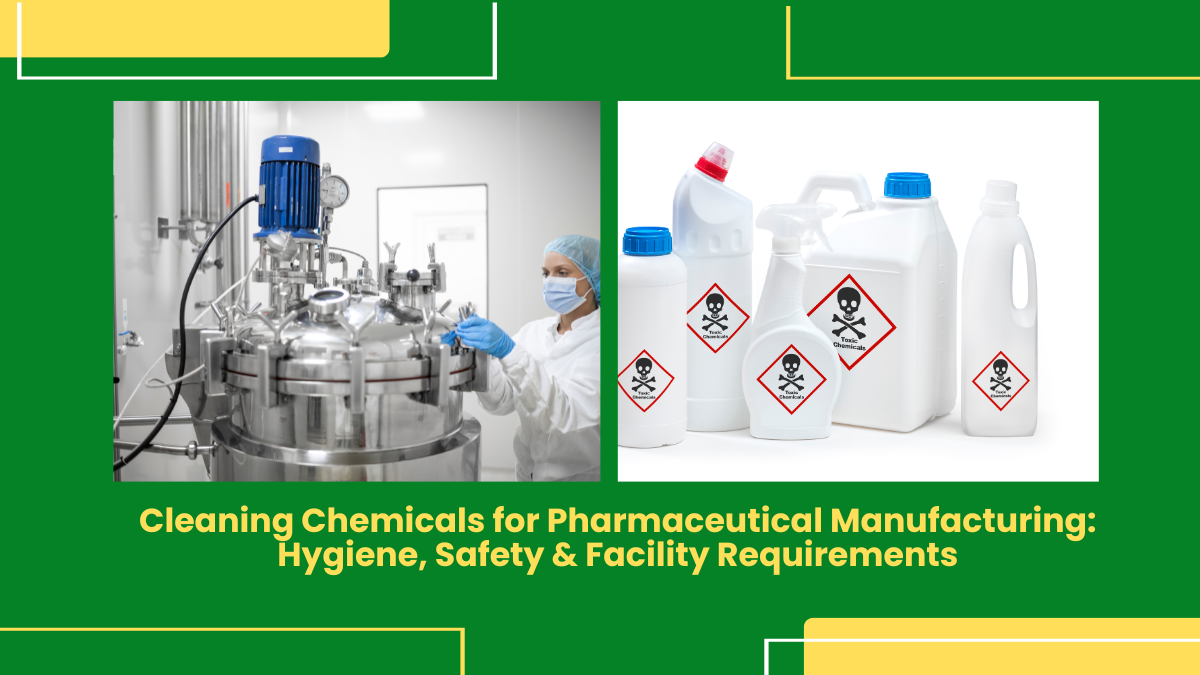
Pharmaceutical manufacturing facilities require a higher level of control over cleaning and hygiene than many conventional commercial environments. Production equipment, floors, walls, storage areas, laboratories, utility spaces and personnel areas all need defined cleaning procedures that help prevent contamination and cross-contamination.
The selection of pharmaceutical cleaning chemicals is therefore not simply a housekeeping decision. The cleaning agent, concentration, application method, contact time, rinsing process, surface compatibility and residue profile can all affect the overall cleaning process.
Good Manufacturing Practice (GMP) places strong emphasis on preventing contamination and cross-contamination during pharmaceutical production. WHO guidance also identifies residues from previous products, cleaning agents, disinfectants, dust, lubricants and other materials as potential contamination concerns.
For pharmaceutical manufacturers, the goal is to establish a controlled cleaning system in which the right chemical is used for the right surface and application, supported by documented procedures and appropriate verification or validation.
Why Pharmaceutical Cleaning Requires Special Attention
A pharmaceutical plant may contain multiple production areas, shared equipment, laboratories, warehouses, clean areas and support facilities. Different zones can have different cleaning requirements.
Common cleaning challenges include:
- Residues from APIs and excipients
- Product dust and powder deposits
- Oils and lubricants
- Grease and process residues
- Microbial contamination risks
- Cleaning-agent residues
- Difficult-to-reach equipment surfaces
- Cross-contamination between products
- Frequent cleaning of shared equipment
- High hygiene requirements in controlled areas
A cleaning programme needs to address both visible cleanliness and the risks associated with residues and contamination.
WHO guidance states that cleaning procedures should be documented and, where applicable, validated, particularly for critical cleaning such as product-contact surfaces and product changeovers.
Problems Faced During Pharmaceutical Facility Cleaning
1. Product and Process Residues
Pharmaceutical production can leave behind active ingredients, excipients and other process materials.
These residues may be difficult to remove, particularly when they have dried or accumulated in equipment joints, valves, seals or other difficult-to-access locations.
Solution
Cleaning chemicals should be selected according to the type of residue and the surface being cleaned.
The cleaning process may require a defined sequence involving pre-cleaning, chemical application, mechanical action, rinsing and inspection. The selected process should be demonstrated to achieve the required level of cleanliness.
2. Cross-Contamination Risk
A shared manufacturing environment can create a risk of transferring residues from one product or batch to another.
This is particularly relevant in multiproduct facilities.
Solution
Develop area- and equipment-specific cleaning procedures. Product changeovers should have defined cleaning requirements, and critical cleaning processes should be supported by appropriate cleaning validation.
WHO identifies cleaning validation as an important control for demonstrating that equipment can be consistently cleaned to acceptable levels of product, detergent and microbial residues.
3. Cleaning Chemical Residues
A cleaning product may remove pharmaceutical residues but itself leave behind unwanted residues if the formulation, concentration or rinsing process is unsuitable.
Solution
When evaluating cleaning chemicals for pharmaceutical industry applications, consider:
- Chemical composition
- Recommended concentration
- Cleaning effectiveness
- Surface compatibility
- Rinsability
- Residue characteristics
- Required water quality
- Temperature requirements
- Contact time
- Storage requirements
WHO guidance specifically recommends selecting cleaning agents based on cleaning-process development and cleanability studies, with evidence supporting their effectiveness and suitability for the intended use.
Types of Pharmaceutical Cleaning Chemicals
There is no single chemical suitable for every pharmaceutical cleaning application. Facilities may require different product categories depending on the contamination and area.
Detergent-Based Cleaners
These products can be used for routine removal of dirt, process residues and other soils from suitable surfaces.
The formulation should be selected according to the surface and type of contamination.
Alkaline Cleaners
Alkaline formulations can be useful for certain organic residues, fats, oils and process soils. Their suitability depends on the formulation and the material being cleaned.
Acidic Cleaners
Acidic formulations may be used for specific inorganic deposits such as mineral scale or other compatible residues.
They should not be used indiscriminately, as some surfaces and equipment materials can be affected by acidic chemistry.
Degreasers
Manufacturing facilities may use suitable degreasers for equipment exteriors, maintenance areas, machinery and other applications involving oil and grease.
Industrial cleaning chemicals for pharma should be selected according to the actual contamination rather than simply choosing the strongest available product.
Disinfectants and Sanitising Products
Cleaning and disinfection are separate processes.
Cleaning removes soil and residues, while an appropriate disinfectant is used when microbial reduction is required. A disinfectant should therefore be selected according to the facility’s validated procedures and intended application.
Pharmaceutical Plant Cleaning: Area-Wise Requirements
Different parts of a pharmaceutical facility can have different cleaning priorities.
| Facility Area | Typical Cleaning Focus |
|---|---|
| Production rooms | Product residues, dust and surface cleanliness |
| Manufacturing equipment | Product and process residues |
| Packaging areas | Dust, product residues and general hygiene |
| Warehouses | Dust, dirt and spill management |
| Laboratories | Controlled cleaning according to laboratory procedures |
| Utility areas | Dirt, grease and maintenance-related contamination |
| Floors | Dust, soil and process contamination |
| Washrooms | Hygiene and sanitation |
| Personnel areas | General cleanliness and hygiene |
The exact cleaning process should always follow the facility’s approved SOPs and quality requirements.
How to Select Pharma Housekeeping Chemicals
Choosing pharma housekeeping chemicals requires more than comparing price or cleaning strength.
1. Identify the Contamination
Determine whether the problem involves:
- Product residue
- Powder or dust
- Oil
- Grease
- Mineral deposits
- Organic contamination
- Microbial contamination
This helps identify the appropriate chemical category.
2. Check Surface Compatibility
Pharmaceutical facilities may contain stainless steel, plastics, elastomers, glass, coated surfaces and other materials.
The selected cleaner should be compatible with the intended surface under the actual concentration and temperature conditions.
3. Consider Residue Removal
A cleaning chemical should not solve one residue problem by creating another.
The process should establish how the cleaning agent itself is removed and how residual levels are assessed where required.
4. Define Concentration and Contact Time
The product should be used at the concentration and contact time established by the approved cleaning procedure.
Changing these parameters without appropriate evaluation can affect cleaning performance.
5. Review Documentation
Before introducing a cleaning chemical into a controlled pharmaceutical process, quality and engineering teams may need information such as:
- Product specification
- Safety Data Sheet
- Technical data
- Composition information, where appropriate
- Recommended dilution
- Application instructions
- Storage conditions
- Rinsing requirements
The exact documentation requirements depend on the facility and its quality system.
Prevention Tips for Pharmaceutical Facility Cleaning
A strong cleaning programme focuses on preventing contamination rather than responding to problems after they occur.
Maintain Written Cleaning SOPs
Every critical cleaning activity should have a defined procedure covering the chemical, equipment, concentration, method, contact time, rinsing and inspection requirements.
WHO guidance calls for written SOPs detailing cleaning processes and appropriate validation of applicable cleaning procedures.
Use Dedicated Cleaning Equipment Where Required
Cleaning tools should be controlled to reduce the risk of transferring contamination between areas.
Where risk assessment requires it, dedicated equipment or components may be used.
Control Cleaning Chemical Dilution
Incorrect dilution can result in poor cleaning or unnecessary chemical residues.
Use controlled preparation methods and clearly identified containers.
Train Cleaning Personnel
Operators and housekeeping teams should understand:
- Chemical handling
- Correct dilution
- PPE requirements
- Application method
- Contact time
- Rinsing procedure
- Equipment-specific cleaning instructions
- Chemical storage
- Spill response
Training should be documented according to the facility’s quality system.
Maintain Cleaning Records
Cleaning records provide evidence that required cleaning activities were performed.
Records can include:
- Date and time
- Equipment or area cleaned
- Product/batch context where relevant
- Cleaning chemical used
- Concentration
- Operator identification
- Inspection results
- Deviations or observations
Monitor Cleaning Performance
Visual inspection is an important part of cleaning assessment, but critical pharmaceutical cleaning may also require appropriate sampling and analytical methods.
WHO guidance describes approaches such as swab sampling, rinse sampling and visual inspection for cleaning verification and validation.
Cleaning Validation and Pharmaceutical Cleaning Chemicals
Cleaning validation is a key consideration when cleaning pharmaceutical manufacturing equipment and product-contact surfaces.
The purpose is to provide documented evidence that an approved cleaning process can consistently remove product residues, cleaning-agent residues and microbial contamination to established acceptable levels.
A cleaning validation programme may consider:
- Equipment design
- Product characteristics
- Soil characteristics
- Cleaning-agent selection
- Concentration
- Temperature
- Contact time
- Mechanical action
- Rinsing
- Sampling locations
- Analytical methods
- Acceptance criteria
WHO guidance also recommends considering difficult-to-clean equipment components and shared equipment when developing cleaning validation strategies.
This means pharmaceutical manufacturers should not select cleaning chemicals solely on general marketing claims. The product and cleaning process need to be assessed for the specific application.
How Ecochem Can Support Pharmaceutical Facility Cleaning
Ecochem is an Indian manufacturer of cleaning solutions serving industrial and commercial applications, including manufacturing environments.
For pharmaceutical facilities, cleaning requirements can extend beyond production equipment to floors, washrooms, common areas, maintenance spaces and other facility zones. This creates a need for different cleaning products for different applications.
Ecochem’s broader cleaning range includes categories such as industrial degreasers, floor cleaners, glass cleaners, multi-purpose cleaners, toilet cleaners, hand wash and metal-cleaning solutions.
For facilities evaluating industrial cleaning chemicals for pharma, product selection should be based on the specific area, contamination, surface and approved cleaning procedure.
Where a pharmaceutical manufacturer requires a product for a critical GMP cleaning process, the facility’s quality and validation teams should evaluate the product’s suitability and establish the required evidence before routine use.
Common Mistakes to Avoid in Pharmaceutical Plant Cleaning
Using One Cleaner for Every Application
Different contaminants require different cleaning approaches.
Choosing Chemicals Only on Price
The cheapest chemical may not provide the required cleaning performance, rinsability or documentation.
Increasing Chemical Concentration Without Evaluation
Higher concentration does not automatically mean better cleaning and can create additional residue or surface-compatibility concerns.
Ignoring Contact Time
Removing a cleaner too quickly can affect its ability to work as intended.
Mixing Cleaning Chemicals
Do not mix products unless the manufacturer and approved procedure specifically permit the combination.
Treating Cleaning and Disinfection as the Same Process
Cleaning removes soil. Disinfection addresses microbial control under defined conditions. They should be managed according to the facility’s validated procedures.
FAQ’S
What are pharmaceutical cleaning chemicals?
Pharmaceutical cleaning chemicals are cleaning formulations used in pharmaceutical manufacturing and facility-maintenance applications.
What should pharmaceutical manufacturers consider when selecting cleaning chemicals?
Consider cleaning effectiveness, surface compatibility, chemical composition, concentration, contact time, rinsability, residue characteristics, documentation and compatibility with the facility’s cleaning-validation requirements.
Are industrial cleaning chemicals suitable for pharmaceutical plants?
Some industrial cleaning products may be suitable for specific non-critical or facility applications, but suitability should be established for the intended pharmaceutical use.
Why is cleaning validation important in pharmaceutical manufacturing?
Cleaning validation provides documented evidence that an approved cleaning process can consistently remove specified residues to established acceptable levels and helps control contamination and cross-contamination risks.
Can the same cleaning chemical be used throughout a pharmaceutical facility?
Not necessarily. Production equipment, floors, laboratories, washrooms, warehouses and maintenance areas may have different cleaning requirements. Chemical selection should match the application.
Written By: Vinny Jain